
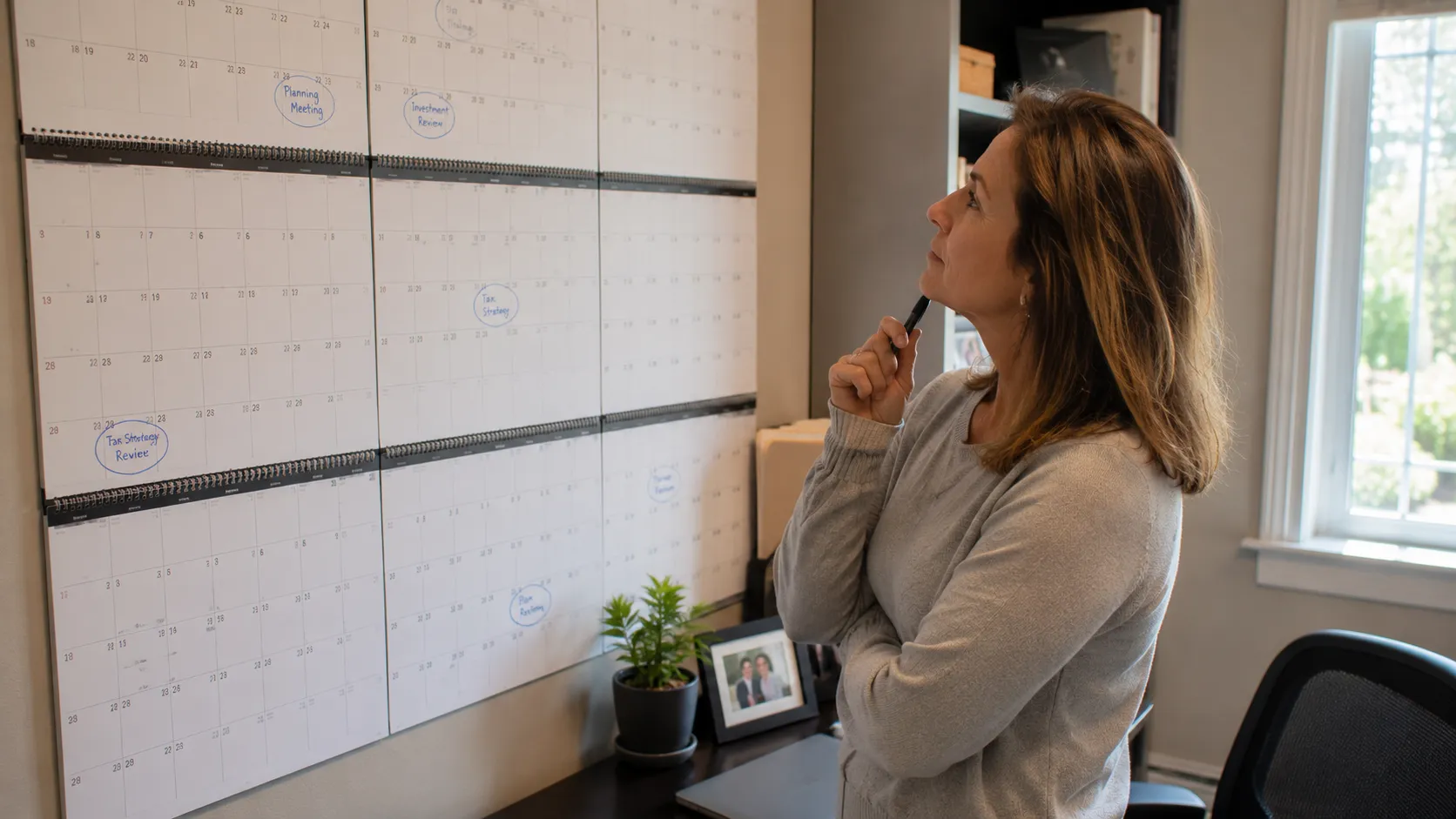
A comprehensive financial plan typically takes 12 to 18 months to build properly – not because the process is slow, but because it moves through distinct phases: fully understanding your situation, designing a roadmap around it, implementing recommendations thoughtfully, and then maintaining the plan as life changes. A single meeting can produce a document, but it generally can’t produce a plan that’s actually been stress-tested against your real, complete financial picture. Here’s why the timeline looks the way it does.
Key Takeaways
- A real financial plan is a process, not a single deliverable – it typically unfolds over 12 to 18 months.
- The timeline is flexible, not fixed – it adjusts based on where you’re starting and how complex your situation is.
- Each phase serves a distinct purpose – rushing one tends to weaken the ones that follow.
- You don’t wait until month 18 to get any value – understanding and clarity build progressively throughout the process.
- A one-meeting plan often misses coordination between investments, taxes, insurance, and estate considerations that only surfaces with real time and attention.
- Planning doesn’t stop after the initial timeline – it shifts into ongoing maintenance as your life continues to change.
Why Does a Real Financial Plan Take Months, Not a Single Meeting?
The honest answer is that a financial life has too many interconnected pieces to responsibly map out in a single sitting – which is exactly why the financial planning process, and the financial plan timeline behind it, unfolds in stages rather than a single conversation.
What Actually Happens During Those 12 to 18 Months?
CCWMG’s Milestone Clarification Process™ generally unfolds over a flexible timeline of 12 to 18 months, moving through structured phases that first gather a complete picture of your finances, then build a roadmap, thoughtfully introduce recommendations, and finally shift into ongoing support. This isn’t 12 to 18 months of waiting – it’s 12 to 18 months of a process actively unfolding in stages.
Why Is the Timeline Flexible Rather Than Fixed?
The process is explicitly flexible, based on where you’re starting – someone with a straightforward financial picture may move through the phases faster than someone with a business, multiple properties, or complex family circumstances. A rigid, one-size-fits-all timeline would either rush complex situations or artificially slow down simple ones.
What Happens in Each Phase of the Process?
Understanding what each phase actually accomplishes explains why skipping ahead tends to weaken the final result – and why the financial planning phases are sequenced the way they are within CCWMG’s broader wealth management process.
What Does the Clarify Phase Actually Involve?

Clarify involves a full financial assessment to define what matters most to you – this is where cash flow, protection, taxes, investments, and legacy considerations are all gathered and understood, not assumed. Nothing in the later phases can be reliably designed around information that wasn’t fully gathered here first.
What Happens During Design, Implement, and Maintain?
Design is where your team builds a personalized roadmap using the LIFE Vision portal, aligning your goals with real data; Implement introduces recommendations thoughtfully and only when appropriate – always optional; and Maintain is the ongoing phase once initial clarity has been achieved. Each phase depends on the one before it – a roadmap built on an incomplete picture, or recommendations implemented before the roadmap is clear, tends to produce a weaker plan than the sequence intends.
Why Do One-Meeting Financial Plans Tend to Fall Short?
It’s worth being direct about what typically gets sacrificed when planning is compressed into a single conversation.
What Gets Missed When Planning Is Rushed?
A single meeting rarely allows time to fully understand cash flow patterns, review existing insurance and estate documents, coordinate with a tax picture, and translate all of it into a roadmap that’s actually been checked against real data – something tends to get approximated rather than genuinely understood. This is part of why CCWMG’s process treats investments as only one component of a much larger planning process, rather than the primary focus of a quick conversation.
Why Does Coordination Take Genuine Time to Get Right?
Tax, investment, insurance, and estate decisions all affect each other, and identifying where they conflict or reinforce one another requires actually looking at the full picture together – something that’s difficult to do reliably in a single sitting, regardless of how experienced the advisor is. Real coordination is a process of cross-checking, not a single insight delivered in an hour.
What Should You Expect to Happen at Different Points in the Timeline?
Knowing roughly what to expect early versus later can make the process feel less open-ended.
What Happens Early On, in the First Few Months?
The earliest months are generally focused on the Clarify phase – gathering a complete picture and defining what actually matters to you – which sets the foundation for all subsequent phases of the planning process. This phase tends to involve the most information-gathering and the least visible “output,” even though it’s arguably the most important part of the process.
What Happens Later, as the Plan Moves Toward Implementation?

As the process moves into Design and then Implement, the work becomes more visible – a roadmap takes shape, and specific recommendations are introduced thoughtfully rather than all at once. Recommendations are explicitly introduced only when appropriate, and always optional – implementation is paced deliberately, not rushed to hit a deadline.
Does a Long Timeline Mean You’re Not Getting Value Right Away?
A 12-to-18-month process doesn’t mean waiting a year and a half to get anything useful out of it.
What Value Do You Get Before the Full Plan Is Complete?
Clarity itself – genuinely understanding your own financial picture for the first time – is a real, immediate benefit that many clients describe experiencing well before the full plan is finished. CCWMG notes that clients consistently describe the process as the first time their finances “finally made sense” – a shift in understanding that tends to happen progressively, not all at once at the very end.
What Happens After the Initial 12 to 18 Months?
Once clarity is achieved, the plan shifts into ongoing maintenance and support – the relationship continues with ongoing support and adjustments as life circumstances, tax law, and goals change over time. The 12-to-18-month timeline describes the initial planning arc, not the full length of the relationship.
Frequently Asked Questions
Can the process move faster than 12 to 18 months if my situation is simple? Possibly – the timeline is explicitly flexible based on where you’re starting, so a more straightforward financial picture may move through the phases more quickly than a complex one.
Do I have to wait until the end of the process to see any results? No – clarity and understanding tend to build progressively throughout the process, and recommendations are introduced thoughtfully during the Implement phase rather than being held back until a single final reveal.
Wondering What a Real Planning Timeline Would Actually Look Like for You?
A single meeting can produce a document – it’s much harder for it to produce a plan that’s actually been checked against your real, complete financial picture. Creative Capital Wealth Management Group’s complimentary Second Opinion Service™ is a low-pressure way to see what that process would actually look like for your situation.