

Best Tax Planning Services for High Net Worth Individuals: How to Minimize Taxes and Preserve Wealth
Effective tax planning for high-net-worth individuals goes well beyond annual filing – it involves coordinating tax strategy with investment decisions, estate planning, and charitable giving into a single, proactive approach built around a specific financial picture. The goal is a coordinated process that minimizes tax liabilities through specific strategies working in unison. Here’s what that actually involves, and what to look for in a tax planning service.
Key Takeaways
- Effective tax planning is proactive, not reactive – built year-round, not assembled in the weeks before filing.
- Estate and gift tax planning is a core part of preserving wealth across generations, not a separate consideration.
- International tax obligations are genuinely complex and worth flagging directly to any advisor if they apply to your situation.
- Philanthropic giving strategies can reduce tax liability while supporting causes that matter to you.
- Integrated planning – tax, investment, and estate together – tends to outperform managing each in isolation.
- The right tax planning service should offer both technical expertise and genuine discretion.
What Are the Core Tax Planning Strategies for High Net Worth Individuals?
The foundation of effective tax planning isn’t a single strategy – it’s an ongoing process built around a client’s specific income sources, assets, and goals.
How Do Bespoke Tax Minimization Strategies Work?
Rather than applying a generic checklist, effective tax minimization starts with understanding a client’s specific income sources, asset types, and timeline, then applying strategies like tax-loss harvesting, gain offsetting, and thoughtful asset location accordingly. CCWMG incorporates tax-loss harvesting, gain offsetting, and tax-efficient transition planning as an ongoing part of coordinating investment decisions with each client’s broader financial picture, rather than treating tax planning as a once-a-year task.
Why Is Estate and Gift Tax Planning Crucial for Wealth Preservation?
Estate and gift tax planning determines how efficiently wealth transfers to the next generation, and decisions made well in advance of a transfer often have the biggest impact on the outcome. Federal estate and gift tax rules are periodically adjusted through legislation, so specific exemption thresholds should be confirmed with a tax professional before implementing a strategy, rather than relying on figures that may have since changed.
How Can International Tax Compliance Enhance High Net Worth Tax Planning?
For individuals with foreign accounts, assets, or income, international tax compliance for HNWIs – including FATCA and FBAR compliance – adds real complexity that domestic-only planning doesn’t need to address.
What Are the Key International Tax Obligations for HNWIs?
US taxpayers with foreign financial accounts may have reporting obligations under FATCA (Foreign Account Tax Compliance Act, generally requiring Form 8938 for certain foreign assets) and FBAR rules (FinCEN Form 114, generally required when foreign accounts collectively exceed $10,000 at any point during the year). These requirements carry real penalties for noncompliance, so anyone with foreign accounts or assets should confirm current requirements directly with a qualified tax professional experienced in this specific area.
How Do Cross-Border Investments Impact Tax Planning?
Cross-border investments can trigger additional complexity, including potential double taxation (often mitigated through foreign tax credits or applicable tax treaties) and special rules for foreign mutual funds classified as Passive Foreign Investment Companies (PFICs). This is a genuinely specialized area of tax law – if international tax obligations apply to your situation, it’s worth confirming directly whether a specific advisor has relevant experience in this area before assuming general tax planning expertise covers it.
Which Philanthropic Tax Strategies Are Best for Wealthy Individuals?

For charitably inclined individuals, charitable giving tax strategies can reduce tax liability while genuinely supporting causes that matter, rather than treating the tax benefit and the giving as separate decisions.
How Does Charitable Giving Reduce Tax Liabilities?
Charitable contributions can reduce taxable income, and for those age 70½ or older, Qualified Charitable Distributions (QCDs) allow funds to be sent directly from an IRA to a qualifying charity, excluding the amount from taxable income entirely while counting toward a required minimum distribution. CCWMG’s Tax Strategies approach includes charitable gifting structures as part of its broader strategic transition and gain management planning.
What Are the Most Effective Structures for Philanthropic Planning?
Donor-advised funds and charitable trusts are two commonly used structures, each offering different tradeoffs between simplicity, control, and timing flexibility for charitable giving. The right structure depends on the size and timing of the intended gift, as well as how much ongoing control over distribution timing matters to the donor.
How Does Integrated Financial Planning Support Tax Efficiency for High Net Worth Clients?
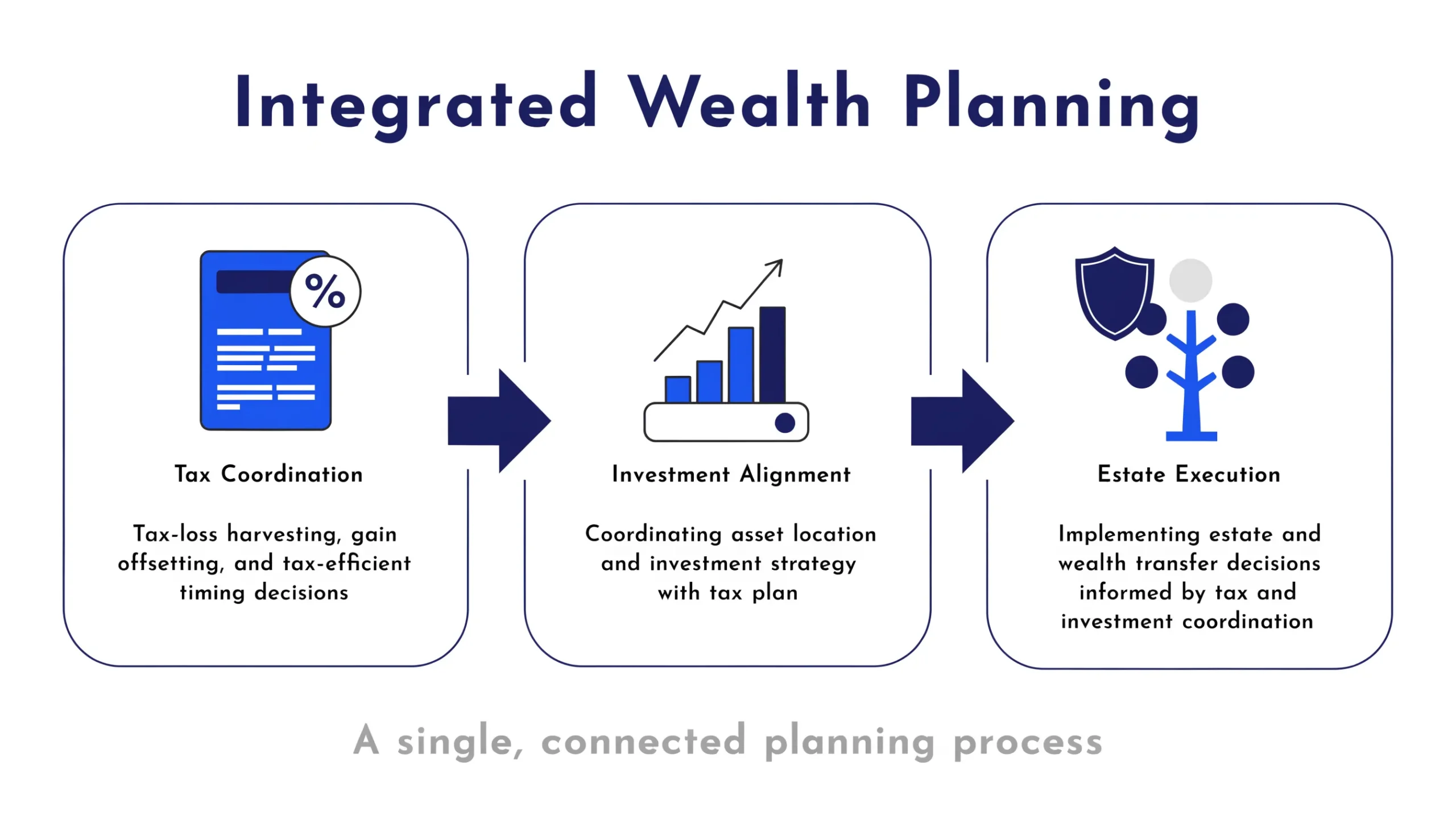
Tax strategy rarely works in isolation – integrated wealth management planning is most effective when tax strategy is coordinated with the rest of a client’s financial plan.
Why Is Coordinating Tax, Investment, and Estate Planning Important?
A tax decision made without considering its investment or estate implications can create problems elsewhere – for example, a tax-efficient move in one account might complicate an estate planning goal in another. CCWMG’s Milestone Clarification Process™ (MCP™) coordinates tax planning with investment strategy and estate considerations as a single, connected process, rather than as separate services handled by disconnected professionals.
How Do Personalized Advisory Services Improve Outcomes?
Generic tax advice applied uniformly tends to miss situation-specific opportunities – a strategy that makes sense for one high-net-worth client may not fit another with a different asset mix or timeline. Personalized advisory service means the plan is actually built around a client’s specific numbers, not a general best-practices checklist.
What Makes Proactive, Long-Term Tax Planning Essential for Sustained Wealth Growth?
Tax planning that only happens once a year tends to miss opportunities that only exist with advance planning – proactive, ongoing attention is what captures them.
How Do Long-Term Tax Mitigation Plans Protect Assets Over Generations?

A long-term tax plan considers not just this year’s return, but how current decisions affect what eventually transfers to the next generation – coordinating investment gains, estate structure, and charitable giving with that longer horizon in mind. This kind of multi-generational thinking is difficult to retrofit after the fact, which is part of why proactive planning matters more than reactive planning.
What Role Does Experienced Professional Support Play in Tax Planning?
Tax law changes regularly, and specialized situations – business ownership, concentrated stock positions, international assets – benefit from professionals with direct experience in those specific areas, not just general tax knowledge. CCWMG operates as a fiduciary, meaning tax-related recommendations are meant to be built around what serves the client, not around which strategy is easiest to implement.
How to Choose the Best Tax Planning Service for High Net Worth Individuals?
With the stakes this high, the selection process deserves the same scrutiny as any other major financial decision.
What Should Clients Look for in Expertise and Discretion?
When evaluating high net worth tax planning services, look for verifiable credentials, direct experience with situations similar to yours, and a firm that treats client information with genuine discretion – not just a stated privacy policy. It’s reasonable to ask directly about experience with your specific situation, whether that’s business ownership, significant charitable intent, or multi-state tax exposure.
How Do Customized Solutions and Client-Centric Service Differ?
A client-centric tax planning service builds the strategy around your actual numbers and goals, rather than applying the same template regardless of situation. CCWMG’s complimentary Second Opinion Service™ is one way to evaluate this firsthand – seeing how a firm approaches your specific situation before committing to anything further.
Frequently Asked Questions
Do I need a specialized advisor if I have foreign accounts or assets? It’s worth confirming directly – international tax compliance (FATCA, FBAR, PFIC rules) is a genuinely specialized area, and not every tax planning service has direct experience with it, so asking specifically about this experience is a reasonable step before assuming it’s covered.
Is tax planning only relevant during tax season? No – the most effective strategies, like tax-loss harvesting and coordinated gain realization, require attention throughout the year, not just when preparing a return.
Ready for Tax Planning That Actually Coordinates With the Rest of Your Wealth?
Minimizing taxes isn’t about one clever move – it’s about a coordinated approach that considers your investments, your estate, and your goals together. Creative Capital Wealth Management Group’s Second Opinion Service™ is a straightforward way to see what that kind of coordinated tax planning could look like for you.