

A 1031 exchange requires selling an investment property and acquiring a like-kind replacement within strict IRS deadlines. Investors must identify a replacement property within 45 days and close within 180 days. Delaware Statutory Trusts (DSTs) offer fractional ownership in large-scale commercial properties, functioning as a passive real estate replacement property that enables tax deferral while professional managers handle operations.
Key Takeaways
A DST 1031 exchange requires selling an investment property and acquiring like-kind replacement within strict IRS deadlines.
Investors must identify a replacement property within 45 days and close the exchange within 180 days.
A Qualified Intermediary holds sale proceeds to prevent constructive receipt by the investor during the exchange process.
DST fractional interests satisfy the like-kind requirement under IRS rules for qualifying commercial real estate properties.
What is a DST 1031 Exchange?
A DST 1031 Exchange Process combines two distinct mechanisms: a 1031 exchange and a Delaware Statutory Trust. A 1031 Exchange is an IRS-recognized tax deferral strategy. It allows an investor to sell an investment property and acquire a similar property to defer capital gains and depreciation recapture taxes.
A Delaware Statutory Trust (DST) is an investment vehicle used to hold commercial real estate assets. DSTs offer accredited investors an effective real estate investment solution with several potential benefits. A DST allows investors to participate in large-scale properties while leaving management to experienced professionals.
How does a DST fit into a 1031 exchange?
The exchange proceeds from a sold property fund the purchase of a fractional interest in a DST. The DST itself holds title to commercial real estate. This structure satisfies the like-kind requirement under IRS rules.
What properties qualify for a DST 1031 exchange?
Qualifying properties include multifamily housing, medical office space, and distribution facilities. The DST structure removes direct ownership burdens such as tenant issues, capital calls, and financing responsibilities. Investors seeking a comparison of these structures should review the key differences between DSTs and 1031 exchanges.
What are the prerequisites for a DST 1031 Exchange?
A DST 1031 Exchange Process begins with meeting specific IRS requirements before any sale closes. The transaction derives its name from Internal Revenue Code 1031, which governs tax-deferred exchanges of investment real estate. Missing any prerequisite forfeits the entire deferral.
What qualifies an investor for a DST 1031 Exchange?
Investors must hold accredited status to participate in DST investments. The property sold and the replacement property must both be held for investment or used in a trade or business. Personal residences and dealer inventory do not qualify.
What steps must occur before the exchange?
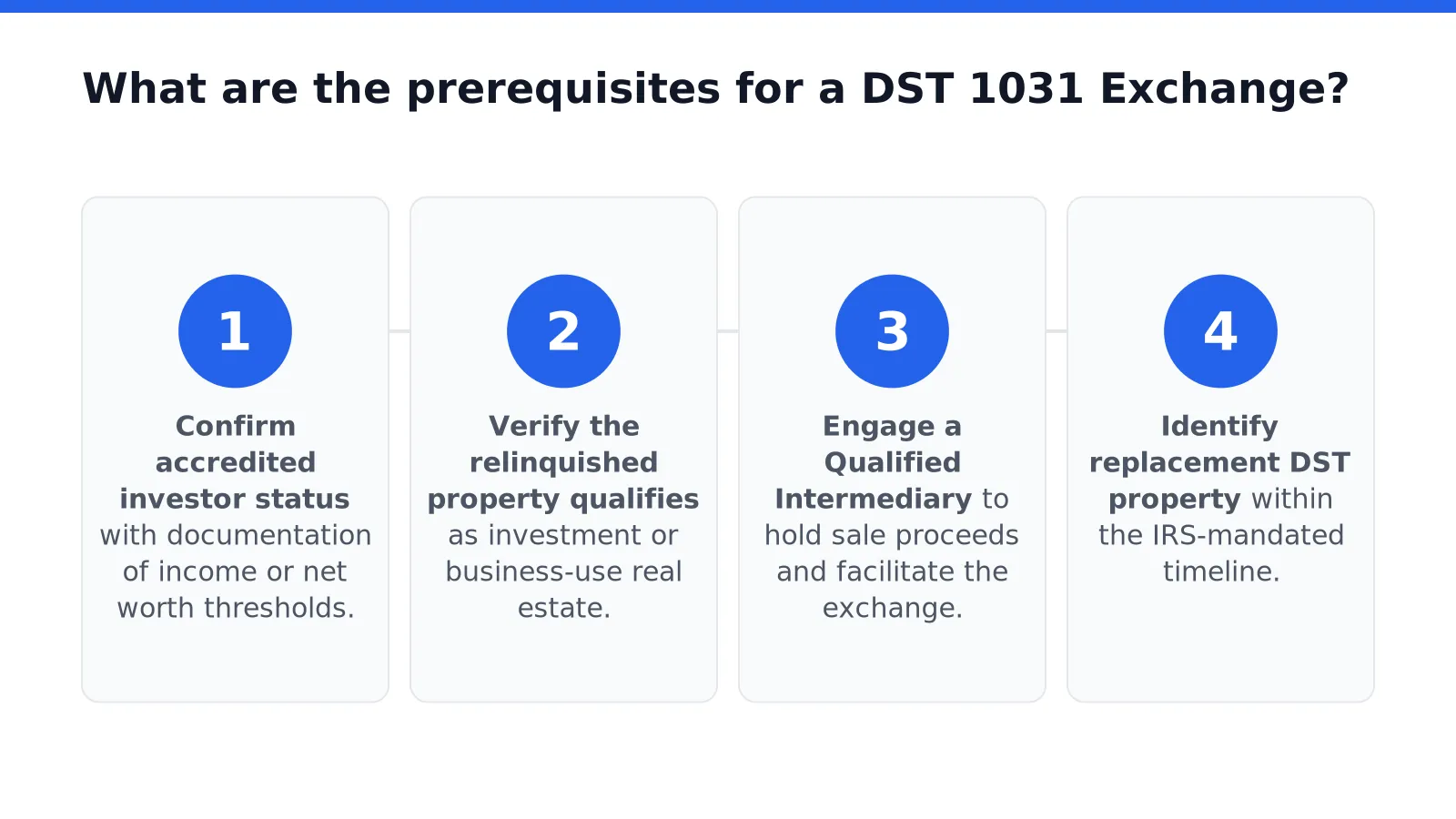
1️⃣ Confirm accredited investor status with documentation of income or net worth thresholds.
2️⃣ Verify the relinquished property qualifies as investment or business-use real estate.
3️⃣ Engage a Qualified Intermediary to hold sale proceeds and facilitate the exchange.
4️⃣ Identify replacement DST property within the IRS-mandated timeline.
IRS exchange rules are rigid. The 1031 exchange timeline must be strictly followed to qualify for tax deferral. A Qualified Intermediary holds proceeds from the sale, preventing constructive receipt by the investor. Finding and vetting suitable replacement property requires advance planning. Investors who skip these prerequisites lose the capital gains and depreciation recapture deferral entirely.

DST Replacement Property Identification: How Do You Identify Property Within 45 Days?
The 1031 exchange 45 day rule starts the moment the relinquished property closes. Missing this deadline forfeits the entire tax deferral. The IRS enforces this timeline rigidly, with no exceptions for weekends or holidays. Investors must deliver a written identification of potential replacement properties to their Qualified Intermediary within this window. The DST 1031 Exchange Process offers a streamlined path for meeting this requirement through fractional ownership in institutional-grade commercial real estate.
What happens if the 45-day deadline falls on a weekend or holiday?
The deadline remains fixed. No extension applies. The IRS does not adjust the 45-day window for calendar convenience. Investors who fail to submit written identification by day 45 lose eligibility for tax deferral on the entire exchange. The consequences are permanent and irreversible.
How does a DST simplify the identification process?
A Delaware Statutory Trust allows investors to identify fractional interests in large-scale commercial properties as replacement assets. These properties include multifamily housing, medical office space, and distribution facilities. The structure eliminates the need to source and vet individual properties under extreme time pressure. Instead, investors identify pre-vetted DST offerings that align with their exchange requirements.
The identification process follows a strict sequence:
1️⃣ Close the sale of the relinquished property to start the 45-day clock.
2️⃣ Research available DST offerings that match investment criteria and exchange value requirements.
3️⃣ Submit a written list of identified replacement properties to the Qualified Intermediary before day 45 expires.
The Three-Property Rule permits identifying up to three properties regardless of total value. DST fractional interests count toward these limits just as whole properties do. The written identification must be unambiguous and include specific property descriptions or DST offering details. Verbal identification carries no weight with the IRS.
How do you close the exchange within 180 days?
Closing a DST 1031 Exchange Process requires strict adherence to IRS deadlines. The 180-day closing period runs concurrently with the 45-day identification period, both starting from the sale of the relinquished property. Missing either deadline forfeits the entire tax deferral.
The investor must acquire the replacement property by the earlier of 180 days or the tax return due date for the year of the sale. This dual deadline catches many property owners off guard. A sale closing in November leaves far less than 180 days if the tax filing deadline arrives first.
What happens if the replacement property does not close in time?
The exchange fails. Capital gains taxes and depreciation recapture become immediately due. The IRS offers no extensions for the 180-day window, regardless of circumstances.
How does debt matching affect the closing?
Debt matching is critical at closing. The investor must replace the full amount of debt on the relinquished property to avoid taxable boot.
A DST can facilitate the closing process by providing a pre-vetted, institutional-grade property that meets the like-kind requirement. This eliminates the search and due diligence delays that commonly derail exchanges in the final weeks.
Follow this sequence to close within the deadline:
1️⃣ Identify replacement property within 45 days of the relinquished property sale.
2️⃣ Execute the purchase agreement on the selected DST interest or replacement property.
3️⃣ Verify debt replacement matches or exceeds the relinquished property’s mortgage balance.
4️⃣ Complete the closing before day 180 or the tax return due date, whichever comes first.
The 180-day clock never pauses. Investors who delay vetting replacement options risk losing the entire deferral benefit.
What common mistakes should you avoid?
The DST 1031 Exchange Process carries rigid IRS requirements that leave no room for error. Missing a single deadline or procedural step forfeits the entire tax deferral, turning a planned exit into an immediate capital gains liability.
What happens if the 45-day identification deadline is missed?
The 45-day identification window cannot be extended under any circumstance. IRS exchange rules are very rigid, and the 1031 exchange timeline must be strictly followed to qualify for tax deferral. Investors who fail to identify suitable replacement property within this period lose the exchange entirely. The capital gains and depreciation recapture taxes become due in the year of sale.
What causes taxable boot in a DST exchange?
Failing to match debt on the replacement property creates taxable boot. A 1031 exchange allows an investor to sell an investment property and acquire a similar property with the intent to defer capital gains and depreciation recapture taxes. When replacement debt falls below the debt retired on the relinquished property, the difference becomes taxable income. Investors must reinvest all net equity and carry equal or greater debt into the replacement DST.
How does constructive receipt invalidate an exchange?
Taking direct control of exchange funds at any point disqualifies the transaction. Many 1031 exchange companies support only a few steps in an exchange transaction, leaving gaps where errors occur. A qualified intermediary must hold the proceeds from sale until the replacement property closes. Any constructive receipt, even briefly, triggers full tax recognition.
Avoiding these pitfalls requires disciplined execution and experienced guidance. Creative Capital Wealth Management Group delivers retainer-based planning backed by salaried Wealth Strategists and deep relationships with alternative investment sponsors. Working with a firm that understands DST structures helps investors navigate the 1031 exchange process without costly missteps.
Frequently Asked Questions
What are the key steps in a DST 1031 exchange process?
Confirm accredited investor status, verify the relinquished property qualifies, engage a Qualified Intermediary, identify a replacement DST property within 45 days, and close the exchange within 180 days.
What is the role of a Qualified Intermediary in a DST 1031 exchange?
A Qualified Intermediary holds the sale proceeds to prevent constructive receipt by the investor, ensuring the exchange qualifies for tax deferral under IRS rules.
Conclusion
The DST 1031 exchange process demands strict adherence to IRS deadlines and debt-matching requirements, with no room for error. Investors who follow the identification and closing sequence precisely secure full tax deferral. Those who delay or overlook critical steps forfeit the benefit entirely. The next step involves confirming accredited investor status and engaging a Qualified Intermediary to begin the exchange timeline.