

A 1031 exchange defers capital gains tax but does not eliminate it: by reinvesting the proceeds from an investment property sale into another “like-kind” property, you postpone the tax bill on the gain rather than paying it in the year you sell. Between federal capital gains tax, depreciation recapture, and the Net Investment Income Tax, a real estate sale without this strategy can trigger a substantial combined tax bill from these sources. Here’s how this capital gains tax deferral actually works, beyond just the basic mechanics.
Key Takeaways
- A 1031 exchange defers – it doesn’t eliminate – capital gains tax, as long as proceeds are reinvested into like-kind real property.
- “Like-kind” for real estate is broad – almost any US investment or business real property qualifies as like-kind to almost any other.
- There are several distinct exchange structures – simultaneous, deferred, reverse, and improvement exchanges – each suited to different situations.
- “Boot” – cash or non-like-kind property received in the exchange – is taxable, even within an otherwise successful exchange.
- Your basis carries over to the replacement property, which affects the tax bill whenever that property is eventually sold.
- This is a genuinely complex, deadline-driven strategy – professional coordination matters more here than in most tax planning decisions.
What Is a 1031 Exchange, and What Does It Actually Defer?
Understanding what’s actually being deferred – and what isn’t – matters before getting into the mechanics.
What Counts as “Like-Kind” Real Property?
For real estate, “like-kind” is interpreted broadly: nearly any US real property held for investment or business use is considered like-kind to nearly any other US real property held for the same purpose, regardless of grade or quality – a rental house can be exchanged for raw land, for example. Real property located outside the United States is not considered like-kind to US property, and since 2018, only real property qualifies for Section 1031 treatment at all – personal property exchanges are no longer eligible.
Does This Only Work for Real Estate?
Correct – following the Tax Cuts and Jobs Act of 2017, Section 1031 was narrowed to apply exclusively to real property, so exchanges of equipment, vehicles, or other personal property no longer qualify for this kind of deferral. CCWMG’s Tax Strategies approach includes 1031 exchange considerations as part of its broader strategic transition and gain management planning, specifically within this real estate context.
What Are the Different Types of 1031 Exchanges?
Not every exchange follows the same structure – which type fits depends heavily on timing and circumstances.
Deferred Exchange Rules: How Do Deferred and Simultaneous Exchanges Differ?
A simultaneous exchange closes both the sale and purchase on the same day, which is straightforward in concept but genuinely difficult to coordinate in practice, making it rare today; a deferred exchange – by far the most common structure – allows the sale and purchase to happen separately, governed by the 45-day identification and 180-day closing deadlines. The deferred structure exists specifically because coordinating a true simultaneous closing is often impractical for real-world transactions.
What Is a Reverse 1031 Exchange, and Why Would You Use One?
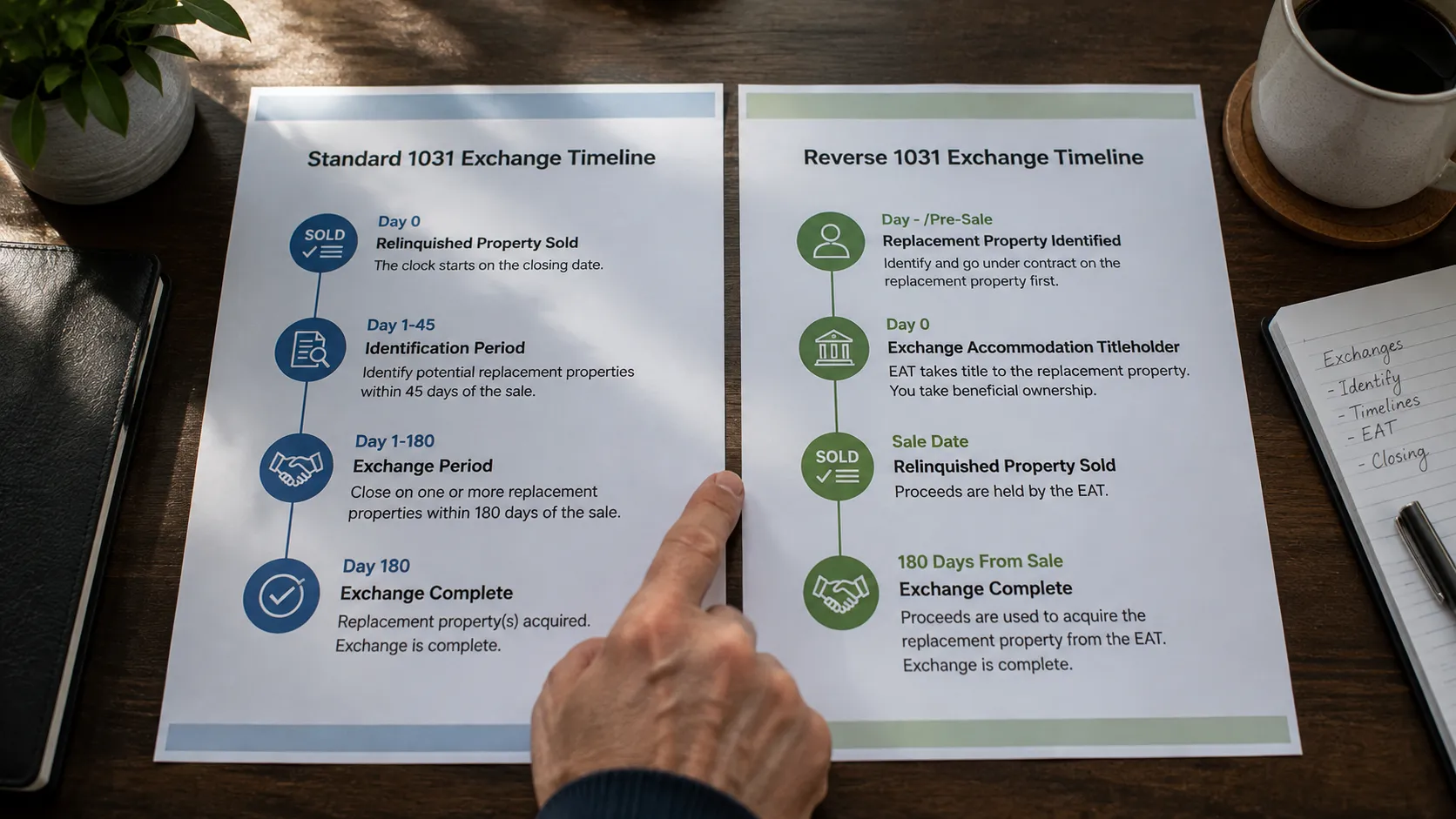
A reverse exchange flips the usual order – you acquire the replacement property first, with a Qualified Intermediary (or Exchange Accommodation Titleholder) holding title temporarily under a specific IRS safe harbor, before you sell your original property within 180 days. This structure is more complex and more expensive than a standard deferred exchange, but it can be worth it in a competitive market where finding and securing the right replacement property is the harder part of the transaction.
Can You Use a 1031 Exchange to Improve a Replacement Property?
For investors who can’t find an ideal like-kind replacement as-is, there’s a structure built specifically for that situation.
How Does an Improvement (Construction) Exchange Work?
An improvement, or construction, exchange allows exchange proceeds to be used to build on or improve the replacement property, rather than requiring the replacement to already meet every need at the time of purchase. This can open up replacement options that wouldn’t otherwise qualify, since the property can be brought up to the desired condition using exchange funds.
What Are the Real Constraints on This Approach?
All improvements must generally be completed within the same 180-day window that governs the rest of the exchange. As a result, this structure requires precise coordination between the property owner, contractor, and Qualified Intermediary – a construction delay or timing error that pushes completion past the 180-day deadline can leave part of the exchange’s intended tax deferral unrealized. This isn’t a flexible, open-ended renovation timeline – it’s bound by the same strict deadline as every other part of the exchange.
What Is 1031 Exchange Boot, and How Does It Affect Your Tax Deferral?
This is one of the most commonly misunderstood parts of a 1031 exchange, and it’s worth understanding precisely.
What Actually Counts as Boot?
Boot is any cash or non-like-kind property received as part of the exchange, and it’s taxable to the extent of its fair market value, even within an exchange that’s otherwise structured correctly. A common source of boot is simply trading down in value – if you sell a property for $500,000 and purchase a replacement for $450,000, the $50,000 difference is generally treated as taxable boot in the year of the exchange.
How Do You Avoid Receiving Boot?
To fully defer the gain, the replacement property generally needs to be of equal or greater value than the relinquished property, and any debt on the replacement generally needs to match or exceed the debt that was paid off on the original – “trading up” in both value and debt is the standard way to avoid triggering boot. This is exactly the kind of detail worth confirming with a qualified intermediary and tax professional before finalizing a specific replacement property.
How Is Your Basis Calculated on the Replacement Property?
The tax consequences of a 1031 exchange don’t disappear – they carry forward into the replacement property’s basis.
What’s the Basic Formula?
Your basis in the replacement property generally starts with your adjusted basis in the relinquished property, decreased by any boot received and increased by any gain recognized on that boot – it isn’t simply reset to the replacement property’s purchase price. This carryover basis is what preserves the deferral: the gain isn’t gone, it’s embedded in a lower basis on the new property.
Why Does This Matter for Your Eventual Tax Bill?

Because basis carries over, the deferred gain remains untaxed only as long as the replacement property is never sold outright – if it eventually is sold without another exchange, that deferred gain and any new appreciation earned while you owned it both become taxable at the time of that sale. The gain escapes tax only if the property is exchanged again instead of sold, or passed to heirs, who generally receive a stepped-up basis. This is why 1031 exchanges are often used as an ongoing strategy across multiple properties over time, rather than a one-time transaction.
Frequently Asked Questions
Can I use a 1031 exchange if I’m downsizing to a less expensive property? You can, but doing so will generally create taxable boot on the difference in value, so the exchange would only partially defer your gain rather than defer it in full.
What happens if I never sell my replacement property? If you continue exchanging or hold the property until death, heirs generally receive a stepped-up basis, which can permanently eliminate the deferred gain rather than merely postponing it – though this depends on your full estate planning picture, not the exchange alone.
Wondering What a 1031 Exchange Would Actually Mean for Your Specific Sale?
The deadlines are strict, the rules around boot are easy to misjudge, and the right exchange structure depends entirely on your specific situation. Creative Capital Wealth Management Group can help you think through whether a 1031 exchange – or a different strategy entirely – makes the most sense for your property.