

How Do I Know if a Wealth Manager Is Trustworthy and Qualified?
A trustworthy, qualified wealth manager operates as a fiduciary, holds credentials you can independently verify, discloses fees clearly, and welcomes direct questions rather than deflecting them. Trust isn’t something to take on faith – it’s something you can actually check. Here’s how.
Key Takeaways
Fiduciary duty means an advisor is legally required to act in your best interest, not just recommend something “suitable.”
Credentials are verifiable through the credentialing body itself and through free regulatory databases.
Fee transparency is one of the clearest early signals of trustworthiness.
The right questions – about philosophy, fees, conflicts, and regulatory history – reveal more than a polished pitch.
Red flags are learnable, and most of them show up early if you know what to look for.
Client reviews and regulatory oversight each tell part of the story, but neither replaces doing your own verification.
Fiduciary duty means an advisor is legally required to act in your best interest, not just recommend something “suitable.”
Credentials are verifiable through the credentialing body itself and through free regulatory databases.
Fee transparency is one of the clearest early signals of trustworthiness.
The right questions – about philosophy, fees, conflicts, and regulatory history – reveal more than a polished pitch.
Red flags are learnable, and most of them show up early if you know what to look for.
Client reviews and regulatory oversight each tell part of the story, but neither replaces doing your own verification.
What Is Fiduciary Duty and Why Is It Essential for Trustworthy Wealth Managers?
Fiduciary duty is the foundation almost everything else in this article builds on – it’s the legal standard that determines whose interests actually come first.
What Does Fiduciary Duty Mean for Clients?
A fiduciary is legally obligated to act in the client’s best interest at all times, rather than simply recommending something that’s “suitable” but not necessarily optimal. Creative Capital Wealth Management Group operates as a fiduciary, which means planning decisions are meant to be made around what serves the client, not around which product pays the advisor more.
How Does Fiduciary Duty Differ From Other Standards?
A “suitability” standard – the requirement historically applied to broker-dealers under FINRA Rule 2111 – only requires that a recommendation be reasonably appropriate, not necessarily the best available option. The difference matters most in situations with competing choices, like a lower-fee option versus a higher-commission one; a fiduciary is required to weigh that difference on your behalf.
How Can I Verify a Wealth Manager’s Qualifications and Professional Certifications?
Credentials matter, but only if they’re real, current, and actually verifiable – not just letters after a name.
What Are the Key Certifications to Look For?
Look for credentials administered by independent, outside organizations – such as Certified Financial Planner (CFP®), Chartered Financial Analyst (CFA), or Chartered Wealth Strategist (CWS®) – each requiring separate education, testing, and ethics standards beyond a firm’s internal training. CCWMG’s team includes certified wealth strategists and certified financial planners, and founder Frederick E. Hubler, Jr. holds an MBA and the CWS® designation.
How Can I Verify Credentials Through Regulatory Bodies?
Most credentialing organizations – including the CFP Board and CFA Institute – offer free public lookup tools on their own websites to confirm whether a specific individual’s designation is active and in good standing. It only takes a couple of minutes, and it’s a more reliable check than taking a bio page at face value.
What Are Common Fee Structures and How Does Fee Transparency Influence Trust?

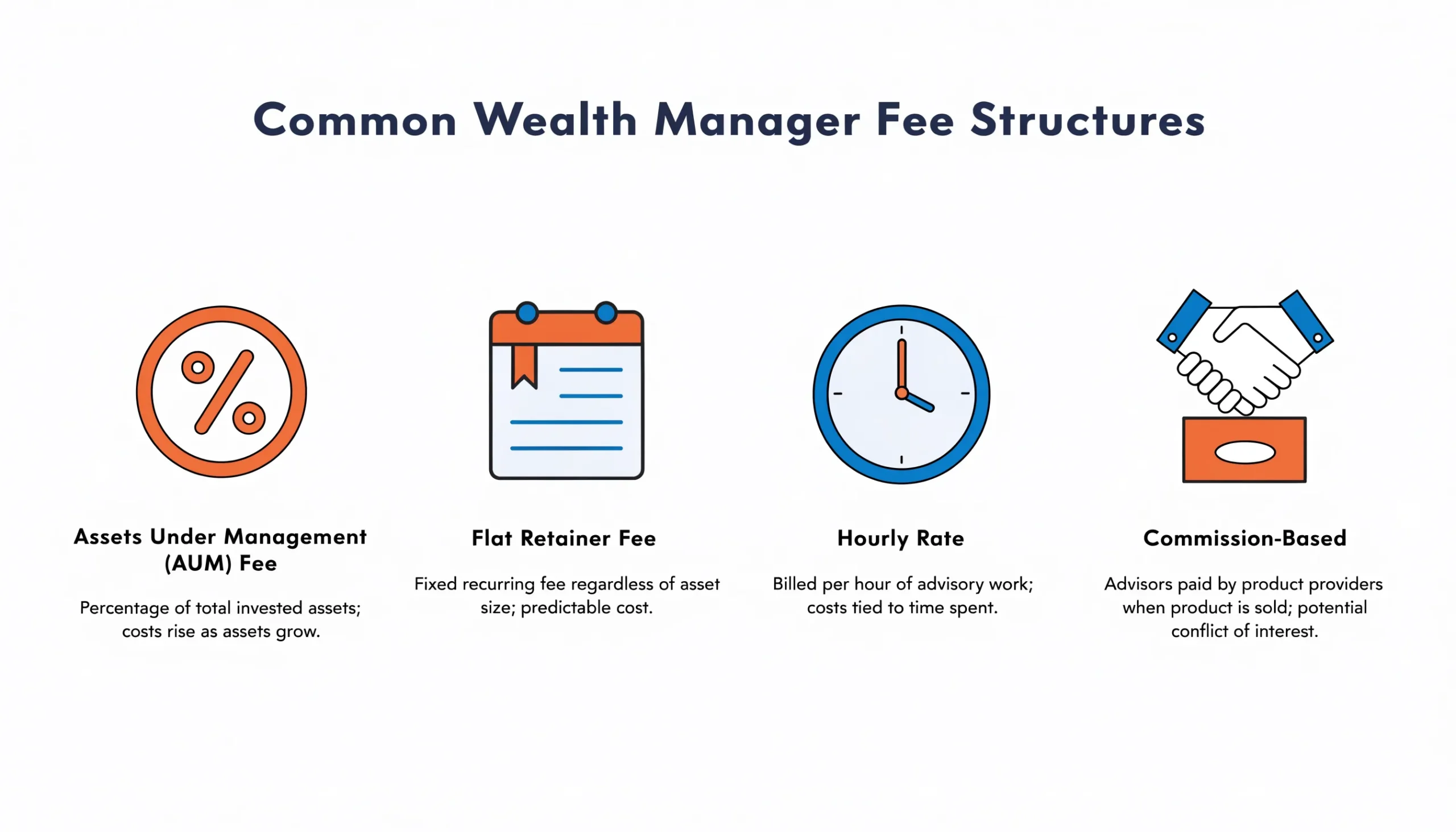
How an advisor gets paid shapes their incentives – which makes fee transparency one of the clearest early trust signals available.
What Types of Fees Do Wealth Managers Charge?
Common models include a percentage of assets under management, flat retainer fees, hourly rates, and commission-based compensation, each creating different incentives. CCWMG’s Milestone Clarification Process™ uses a flat, quarterly retainer rather than an asset-based percentage, so the fee doesn’t shift based on how much is invested.
Why Is Transparent Fee Disclosure Critical?
A trustworthy advisor should be able and willing to provide their full fee structure in writing before you commit to anything, without vague answers or pressure to move quickly. If fee questions get deflected or delayed, that alone is worth paying attention to.
What Essential Questions Should I Ask to Assess a Wealth Manager’s Trustworthiness?
A short, direct list of questions tends to reveal more than any brochure or first impression.
What Should I Ask About Services and Investment Philosophy?
Ask what’s actually included in the relationship – ongoing planning, tax coordination, and estate considerations, or investment management alone – and how the advisor approaches risk and diversification. CCWMG’s complimentary Second Opinion Service™ is designed specifically as a low-pressure way to ask these questions before committing to anything further.
How Do I Inquire About Fees, Conflicts, and Regulatory History?
Ask directly: What’s your full fee schedule, in writing? Are you a fiduciary at all times? Do you earn commissions on any products you recommend? Can I verify your registration myself? Specific, direct answers are a good sign; vague reassurance is not.
What Are the Red Flags That Indicate an Untrustworthy or Unqualified Wealth Manager?

Most red flags aren’t dramatic – they tend to be small inconsistencies that are easy to miss if you’re not looking for them.
Which Behaviors or Claims Should Raise Concern?
Be cautious of guaranteed returns, pressure to decide quickly, vague or evasive answers about fees, and reluctance to explain how they’re compensated. Legitimate wealth management is built around planning and disclosure – not urgency or promises no one can actually make.
How Can I Check for Past Regulatory Actions or Complaints?
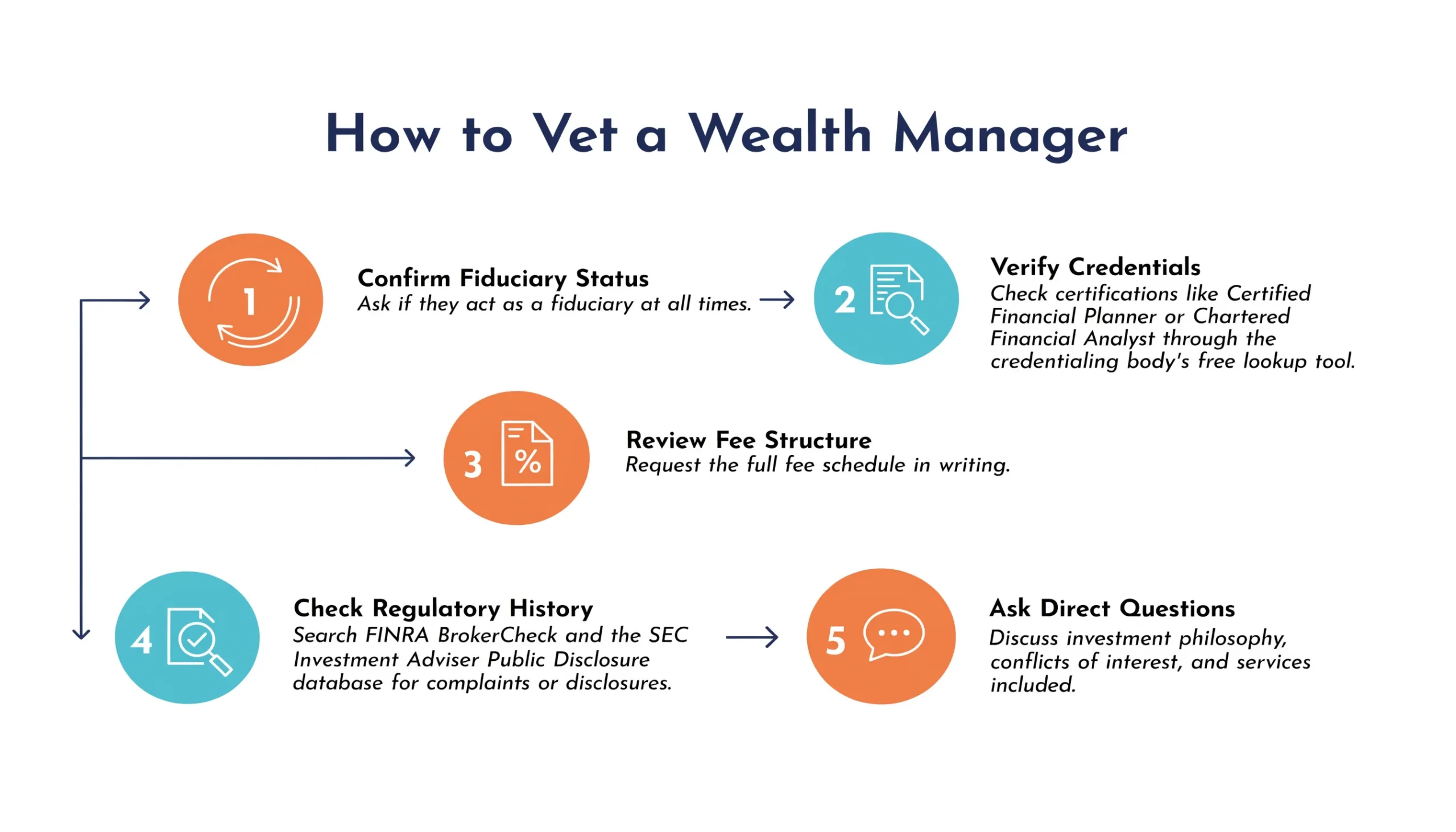
FINRA’s BrokerCheck (brokercheck.finra.org) and the SEC’s Investment Adviser Public Disclosure database (adviserinfo.sec.gov) are free tools that show registration history, licenses, and any disclosure events like complaints or regulatory actions. Checking both takes only a few minutes and is one of the simplest ways to catch a problem before it becomes yours.
How Do Client Testimonials and Regulatory Oversight Support Trust in Wealth Managers?
Reviews and regulatory records each add a piece of the picture, though neither one tells the whole story on its own.
How Can Client Reviews Help Gauge Advisor Credibility?
Client reviews can offer a sense of communication style and day-to-day experience, but they’re inherently limited – they rarely reveal fee structure, conflicts of interest, or regulatory history. Reviews are worth reading, just not worth relying on as your only form of due diligence.
What Role Do Regulatory Bodies Play in Maintaining Advisor Trustworthiness?
Regulatory bodies like FINRA and the SEC maintain public records specifically so clients don’t have to take an advisor’s word for their standing – that’s precisely what makes those tools worth using directly. Combining a firm’s own disclosures with independent verification gives a far more complete picture than either one alone.
Frequently Asked Questions
Is a wealth manager automatically trustworthy if they’re registered with FINRA or the SEC? Registration confirms they’re legally permitted to operate and gives you a place to check their history – it’s a necessary check, not a complete guarantee of quality or fit.
What’s the fastest way to check if someone is actually a fiduciary? Ask them directly, in writing, whether they act as a fiduciary at all times or only in certain contexts – the answer isn’t always as simple as “yes,” and a clear written answer is worth having.
Trust Should Be Easy to Verify, Not Just Assumed
Working with the right wealth manager shouldn’t require a leap of faith – it should hold up to a few direct questions and a couple of minutes of your own research. Wondering how Creative Capital Wealth Management Group holds up to that kind of scrutiny? A conversation is the easiest way to find out.