

Custody-independent retirement planning is achievable through Creative Capital Wealth Management Group’s retainer-based model, addressing the question “Can I Maintain My Current Investments While Working With Your Retirement Planning Services?” Clients retain custody of existing brokerage, real estate, or business holdings while receiving salaried Wealth Strategist guidance. Transparent flat quarterly fees replace commission conflicts, delivering holistic tax, investment, and legacy strategy through the firm’s Virtual Family Office experience.
Key Takeaways
- Retainer-based planning never requires moving assets or changing custodians.
- Flat quarterly fees replace asset-based commissions, eliminating product sales conflicts.
- Wealth Strategists receive salaries, not commissions tied to asset movement or placement.
- The Milestone Clarification Process maps each financial decision to a specific life milestone.
Can I Keep My Current Investments With Your Planning?
Retirement planning does not require surrendering control of existing assets. Creative Capital Wealth Management Group delivers retainer-based planning that never requires moving assets. Clients retain their current brokerage accounts, custodial relationships, and investment positions while receiving comprehensive retirement strategy.
This structure eliminates a common industry friction. Many advisory models demand asset consolidation before any planning begins. The firm’s approach removes that barrier entirely. High-net-worth individuals, business owners, and disciplined pre-retirees maintain their established financial infrastructure. The planning layer sits on top, not in place of, what already works.
How Does Retainer-Based Planning Protect My Existing Portfolio?
The retainer model severs the link between advice and asset custody. Creative Capital Wealth Management Group charges transparent, flat quarterly fees for strategy, not for managing a pool of transferred assets. Clients pay for expertise and ongoing guidance. Their investments stay where they are.
This separation produces a critical benefit: advice free from product sales conflicts. The firm’s Wealth Strategists receive salaries, not commissions tied to asset movement or product placement. Recommendations flow from the client’s goals, tax situation, and legacy objectives. No incentive exists to disrupt a well-performing portfolio to generate fees.
What Happens to My Current Brokerage or Custodian Relationship?
Nothing changes. The existing custodian continues executing trades, holding securities, and providing account statements. Creative Capital Wealth Management Group integrates its Milestone Clarification Process and Wealth Charting into the client’s financial picture without disturbing those relationships. The firm coordinates with accountants, estate attorneys, and other professionals already serving the client.
This coordination creates a Virtual Family Office experience. Strategy spans tax alignment, investment positioning, and legacy planning. Yet the operational backbone, the actual accounts, remains untouched. Clients gain sophisticated oversight without the disruption of transferring assets or rebuilding account structures from scratch.
For those exploring broader retirement frameworks, the firm’s guidance on best wealth management strategies for retirement complements this custody-independent model. The planning integrates with, rather than replaces, existing investment arrangements.
What Is Retainer-Based Retirement Planning?
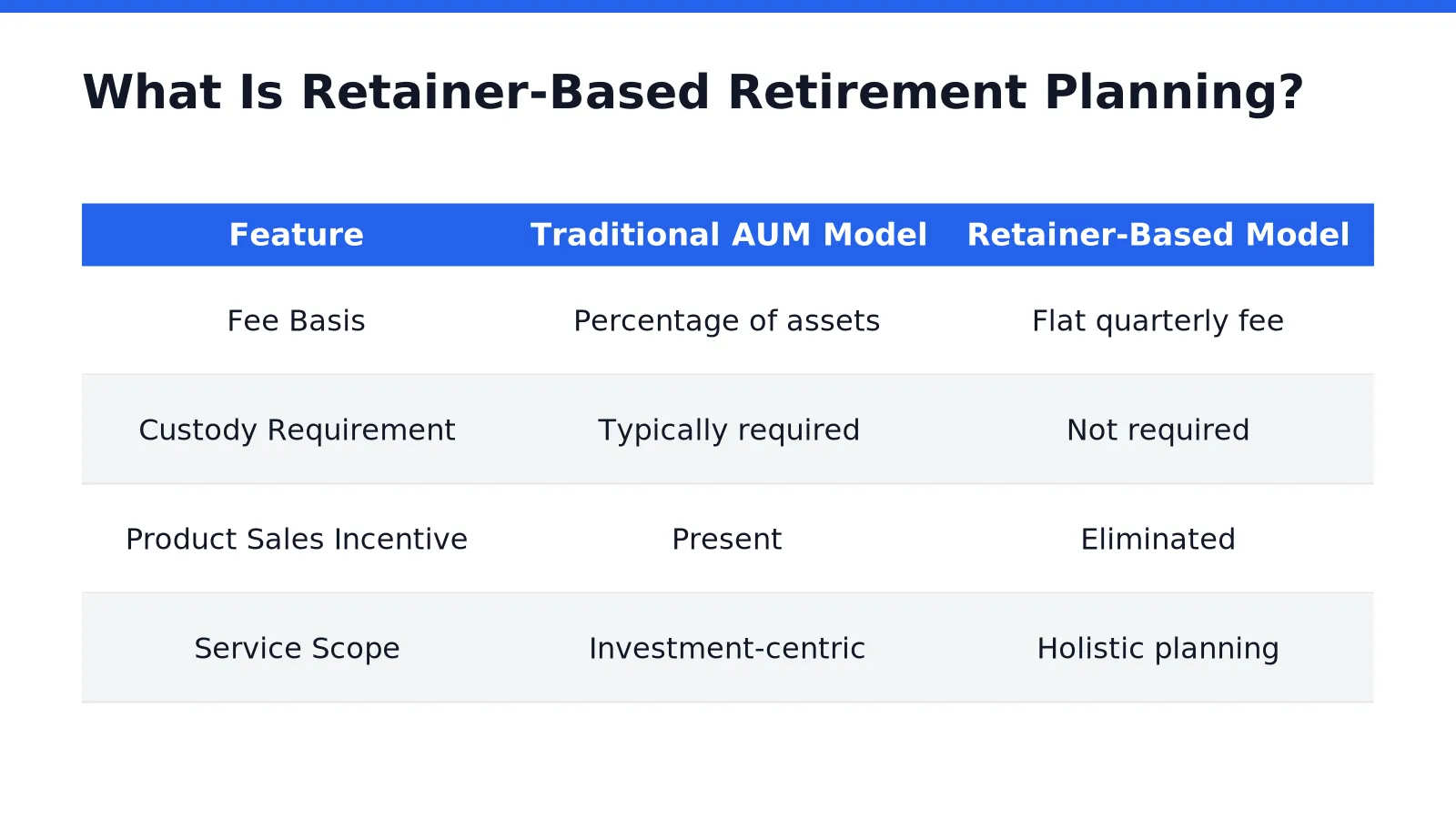
Retainer-based retirement planning replaces asset-based commissions with transparent, flat quarterly fees. Creative Capital Wealth Management Group structures this model to deliver advice free from product sales conflicts. High-net-worth individuals and business owners gain a Virtual Family Office experience without surrendering control of their existing brokerage, real estate, or business assets. The arrangement severs the link between an advisor’s compensation and the products a client buys.
How Does the Fee Structure Differ From Traditional Advisory Models?
Traditional advisors often charge a percentage of assets under management. That model creates an incentive to gather assets rather than optimize a client’s entire financial picture. A retainer arrangement charges a predictable quarterly fee instead. The cost stays fixed regardless of where investments are held. Clients avoid the hidden drag of embedded product commissions and layered expense ratios that erode long-term returns.
Can Clients Keep Their Current Investment Accounts?
Yes. The retainer model does not require moving assets or changing custodians. Creative Capital Wealth Management Group provides planning and strategy while investments remain in place. Business owners with concentrated stock positions, real estate investors with illiquid holdings, and pre-retirees with legacy 401(k) accounts all maintain their existing structures. The company’s Wealth Strategists integrate tax planning, estate design, and alternative investment access around those assets rather than demanding consolidation.
The flat-fee structure aligns the advisor’s interests with the client’s long-term goals. No commission grid influences the recommendations. The company’s financial planning and wealth management services extend across tax strategy, legacy planning, and accredited alternative investments. Clients receive coordinated guidance that treats existing holdings as components of a unified plan rather than obstacles to be replaced.

How Does the Milestone Clarification Process Work?
The Milestone Clarification Process transforms vague retirement ambitions into a structured, accountable financial roadmap. Creative Capital Wealth Management Group designed this proprietary framework to give high-net-worth individuals and business owners precise clarity on every phase of their retirement journey.
Without a defined process, retirement planning drifts. Unanswered questions about tax exposure, investment alignment, and legacy timing compound silently. The Milestone Clarification Process eliminates that drift by mapping each financial decision to a specific life milestone. Clients see exactly what must happen, when it must happen, and why.
What makes this process different from standard retirement planning?
Traditional planning often stops at asset allocation. The Milestone Clarification Process goes further. It integrates Wealth Charting, a visual coordination tool that aligns taxes, investments, and legacy into a single synchronized plan. Rather than treating each element in isolation, Wealth Charting reveals how a tax decision today reshapes an inheritance outcome twenty years from now. This interconnected view prevents costly disconnects that fragmented planning creates.
Does the process require moving my existing investments?
No asset custody changes are required. The firm’s retainer-based model means clients maintain their current brokerage accounts, real estate holdings, and business assets exactly where they are. The Milestone Clarification Process overlays strategic direction without disrupting existing relationships. It also opens access to accredited investment opportunities that complement a portfolio’s existing structure. These opportunities integrate into the broader plan while taxes, investments, and legacy stay aligned.
Accountability anchors the entire process. Each milestone carries defined action steps and review triggers. The Milestone Clarification Process creates a living framework that adapts as circumstances shift, ensuring retirement strategy never stagnates.

What Retirement Planning Services Do You Offer?
Creative Capital Wealth Management Group delivers retirement planning services built around three integrated pillars: personalized strategy development, investment management, and tax-efficient approaches. These services target high-net-worth executives, retirees, business owners, and entrepreneurs who need sophisticated coordination across their financial lives. Without this integration, clients risk fragmented advice that leaves tax savings unrealized and retirement income streams misaligned with actual spending needs.
The firm’s Wealth Strategists operate on a salaried basis. They earn no commissions on product sales. This structure removes the incentive to recommend investments that generate fees for the advisor rather than returns for the client. A transparent, retainer-based model ensures every recommendation ties directly to the client’s retirement objectives, not to a sales quota.
What makes a retirement strategy fully personalized?
Personalized retirement planning starts with mapping current assets against future income requirements. The process examines existing brokerage accounts, real estate holdings, and business interests without requiring asset custody transfers. Tax-efficient withdrawal sequencing then determines which accounts to tap first, preserving Roth assets for later years and minimizing Medicare premium surcharges. Investment management overlays this plan with allocations calibrated to the client’s specific risk tolerance and legacy goals.
How do tax-efficient strategies protect retirement income?
Tax-efficient strategies address the silent erosion of purchasing power that conventional planning overlooks. Strategic Roth conversions during lower-income years reduce future required minimum distributions. Asset location across taxable, tax-deferred, and tax-free accounts maximizes after-tax returns. Business owners gain additional planning levers through entity structuring and qualified retirement plans. Each tactic preserves capital that would otherwise fund tax obligations rather than retirement lifestyle.
The firm’s retirement planning services extend beyond investment selection to encompass estate coordination and alternative investment access. Clients maintain their existing custodian relationships while receiving institutional-grade strategy typically reserved for family offices. This approach suits disciplined pre-retirees who have accumulated substantial assets and refuse to sacrifice control for convenience.
How Do You Choose a Retirement Planner Without Moving Assets?
Selecting a retirement planner who never requires asset custody transfer demands scrutiny of fee models and fiduciary alignment. High-net-worth individuals and business owners lose strategic continuity when forced to liquidate positions or disrupt long-held brokerage relationships. The right planner integrates existing investments into a holistic retirement strategy without triggering unnecessary tax events or surrender charges.
What Fee Structure Signals True Independence?
A transparent, fee-only wealth management model eliminates the conflicts embedded in commission-driven or assets-under-management arrangements. Creative Capital Wealth Management Group delivers advice free from product sales conflicts, charging flat quarterly retainers instead of earning commissions on recommended products. This structure severs the link between planner compensation and client transactions. Understanding how fees work is crucial, as it directly impacts the financial decisions clients make. Without this clarity, investors risk accepting recommendations that serve the planner’s revenue targets rather than their own retirement outcomes.
Why Does Custody Independence Matter for Existing Portfolios?
Forced asset transfers create three immediate problems: realized capital gains, loss of cost-basis tracking, and disruption of carefully structured income streams. A planner operating without custody requirements preserves the client’s existing brokerage relationships, alternative investment positions, and private placement holdings. The retainer model keeps the advisor focused on strategy rather than gathering assets. Clients evaluating what to look for in local retirement planners should prioritize firms that treat existing portfolios as strategic building blocks, not obstacles to be dismantled.
Key criteria for custody-independent planners:
- Flat quarterly retainer fees with no transaction-based compensation
- Written acknowledgment that assets remain at client-chosen custodians
- Integration of existing alternative investments into the retirement income plan
- Tax-aware rebalancing recommendations that respect unrealized gains
- Direct collaboration with the client’s current CPA and estate attorney
The absence of custody requirements protects decades of accumulated investment history. Business owners with concentrated stock positions and real estate investors with illiquid holdings gain particular advantage from this structure. A retainer-based planner coordinates these assets within a unified retirement roadmap while the client maintains full control over where assets are held.
What Are the Costs of Retainer-Based Planning?
Retainer-based retirement planning costs follow a transparent, flat quarterly fee structure. Creative Capital Wealth Management Group charges no hidden commissions and never requires clients to move existing investment assets.
This fee model eliminates the conflicts common in commission-driven advisory relationships. High-net-worth individuals, business owners, and disciplined pre-retirees gain clarity on exactly what they pay and when. The quarterly cadence creates predictable budgeting while funding ongoing strategic work: tax alignment, investment coordination, estate structuring, and access to accredited alternative opportunities. Transparency in financial planning fees builds trust with high-net-worth clients who demand accountability from their advisors.
How Does the Fee Structure Compare to Traditional Asset-Based Models?
Traditional advisors often charge a percentage of assets under management, creating an incentive to gather more assets. Retainer-based planning decouples advice from custody. Clients maintain current investments at their existing brokerage, real estate holdings, or business accounts without disruption. The flat fee covers the intellectual capital of salaried Wealth Strategists, not product sales or trading commissions.
What Determines the Specific Fee a Client Pays?
Pricing varies by engagement scope. A business owner integrating succession planning, tax strategy, and multi-generational estate design incurs a different level of analytical work than a pre-retiree focused solely on income drawdown. The company tailors each retainer to the complexity of the client’s financial life. Prospective clients contact the firm directly for specific pricing details aligned to their situation.
The absence of asset movement requirements preserves existing relationships and avoids taxable liquidation events. For those evaluating advisory options, understanding how fee transparency correlates with fiduciary alignment proves essential. The broader process of selecting a wealth management firm involves scrutinizing these structural differences carefully.
Can I Access Alternative Investments Without Moving Assets?
Accessing alternative investments does not require transferring existing assets. Creative Capital Wealth Management Group structures retirement plans so clients maintain their current investment positions while adding accredited opportunities. This approach preserves long-held brokerage accounts, real estate holdings, and business interests intact.
The firm’s retainer-based model eliminates the pressure to consolidate assets under one roof. Clients keep their preferred custodians and existing relationships. Alternative investments integrate alongside current portfolios rather than replacing them.
How Do Delaware Statutory Trusts Fit Into a Retirement Plan?
A Delaware Statutory Trust (DST) offers fractional ownership in large-scale commercial real estate. Professional managers handle daily operations, removing the burden of direct property management. These trusts provide exposure to institutional-grade assets without requiring clients to sell existing holdings or transfer accounts.
What Types of Alternative Investments Are Available?
Creative Capital Wealth Management Group maintains deep relationships with alternative investment sponsors. These connections grant access to accredited opportunities typically reserved for institutional investors. The firm aligns these investments with each client’s tax situation, existing portfolio, and legacy goals.
The integration process follows a structured approach:
- The firm evaluates current investment positions and tax implications
- Alternative opportunities are matched to specific portfolio gaps
- New investments are added without disturbing existing asset custody
This method preserves the continuity of long-term investment strategies. Clients gain diversification through private placements, real estate trusts, and other non-correlated assets. The existing brokerage accounts, retirement plans, and real property remain exactly where they are. No liquidation occurs. No transfer paperwork disrupts established financial relationships.
Why Choose Creative Capital for Retirement Planning?
Creative Capital Wealth Management Group delivers retirement planning that preserves existing investment relationships. The firm’s retainer-based model eliminates any requirement to move assets, a distinction that matters for high-net-worth individuals with established brokerage, real estate, or business holdings. Clients receive holistic strategy without custody disruption.
How Does the Firm’s Fee Structure Support Independent Advice?
Transparent, flat quarterly fees replace commission-driven recommendations. This structure removes product sales conflicts entirely. Wealth strategists earn salaries, not commissions, so their incentives align with client outcomes rather than transaction volume.
What Investment Philosophy Guides the Retirement Planning Process?
Three principles anchor every retirement strategy. Tax efficiency minimizes unnecessary erosion of returns across taxable accounts. Risk alignment matches portfolio construction to each client’s actual capacity and timeline, not generic benchmarks. Behavioral discipline protects against reactive decisions during market volatility. These elements work together to sustain purchasing power through decades of retirement.
The firm operates from Chester Springs, PA, and serves clients nationwide through fully virtual collaboration. Geographic distance imposes no barrier to comprehensive planning. Business owners, disciplined pre-retirees, and affluent families access the same rigorous process regardless of location.
Creative Capital’s approach suits individuals who value their current custodian relationships. The planning integrates tax strategy, investment coordination, and legacy design without requiring asset transfers. Clients maintain their existing accounts while gaining professional oversight and accountability. This model respects the trust built with long-standing financial institutions while adding a layer of independent, conflict-free guidance.
FAQ
Do I have to move my assets to work with Creative Capital Wealth Management Group?
No. Retainer-based planning never requires moving assets or changing custodians. Clients retain existing brokerage accounts, real estate, and business holdings while receiving salaried Wealth Strategist guidance.
How does the retainer model keep my advice conflict-free?
Flat quarterly fees replace asset-based commissions, and Wealth Strategists receive salaries, not commissions tied to asset movement. This eliminates product sales conflicts, so recommendations flow from goals, tax situation, and legacy objectives.
What happens to my current brokerage or custodian relationship?
Nothing changes. The existing custodian continues executing trades and providing statements. Creative Capital coordinates with your accountants and attorneys, integrating its Milestone Clarification Process without disturbing those relationships.
Conclusion
Retirement planning without moving assets preserves existing custodian relationships, avoids taxable liquidation events, and maintains long-held investment positions. The retainer-based model provides conflict-free guidance through salaried Wealth Strategists who align tax efficiency, risk management, and behavioral discipline with each client’s unique financial life. For those who value their current brokerage accounts, real estate holdings, and business interests, this approach delivers professional oversight and accountability without requiring asset transfers. The next step involves evaluating how transparent flat quarterly fees and alternative investment access integrate into an existing portfolio structure.