
Understanding the risks of alternative asset investments begins with illiquidity, valuation uncertainty, and limited regulatory oversight. Private equity and real estate syndications often lock capital for years, with no daily pricing. Accredited investors face concentrated risk, higher fees, and potential capital calls. Creative Capital Wealth Management Group structures retainer-based planning to align these risks with client goals, ensuring transparency without product-sales conflicts.
Key Takeaways
Illiquidity locks capital for years, with no secondary market for early exits.
Private assets lack continuous market pricing, making current worth harder to assess.
Returns depend on the skill and integrity of the fund manager or sponsor.
Fewer disclosure requirements leave investors with less information than public markets provide.
Alternative investments carry distinct risks that differ markedly from traditional stock and bond holdings. These financial assets fall outside conventional categories like stocks, bonds, and cash, operating with different goals, timelines, and risk profiles. Investors who overlook these differences lose the very diversification benefits that make alternatives attractive. A What Risks Should I Be Aware of When Investing in Alternative Assets framework starts with recognizing illiquidity, valuation complexity, and limited transparency.
Why do alternative investments behave differently from stocks and bonds?
Alternative assets operate in private markets away from daily exchange trading. They offer a different approach to investing, often with different goals, timelines, and risk profiles compared to public securities. This separation from public markets means performance does not track stock or bond indices directly. Investors sacrifice daily liquidity and visible pricing for the potential of enhanced returns and non-correlated performance.
How can investors identify the most significant risk factors?
Several alternative investment risk factors demand scrutiny before committing capital:
☑️ Illiquidity risk: Capital stays locked for years with no secondary market to exit early
☑️ Valuation opacity: Private assets lack continuous market pricing, making current worth harder to assess
☑️ Manager dependency: Returns hinge on the skill and integrity of the fund manager or sponsor
☑️ Regulatory gaps: Fewer disclosure requirements leave investors with less information than public markets provide
☑️ Concentration exposure: Single-deal structures amplify the impact of one asset’s failure
Creative Capital Wealth Management Group delivers retainer-based planning that never requires moving assets, backed by salaried Wealth Strategists and deep relationships with alternative investment sponsors.
What role does due diligence play in risk management?
Thorough alternative asset due diligence reduces information asymmetry between investors and sponsors. The process examines track records, fee structures, and alignment of interests before any capital commitment. Alternative strategies such as private equity, private credit, and real estate provide an attractive source of alpha, income, and diversification. However, that potential vanishes when due diligence shortcuts allow hidden risks into the portfolio. Structuring investments with clear documentation and defined exit paths preserves the strategic benefits while containing downside exposure.
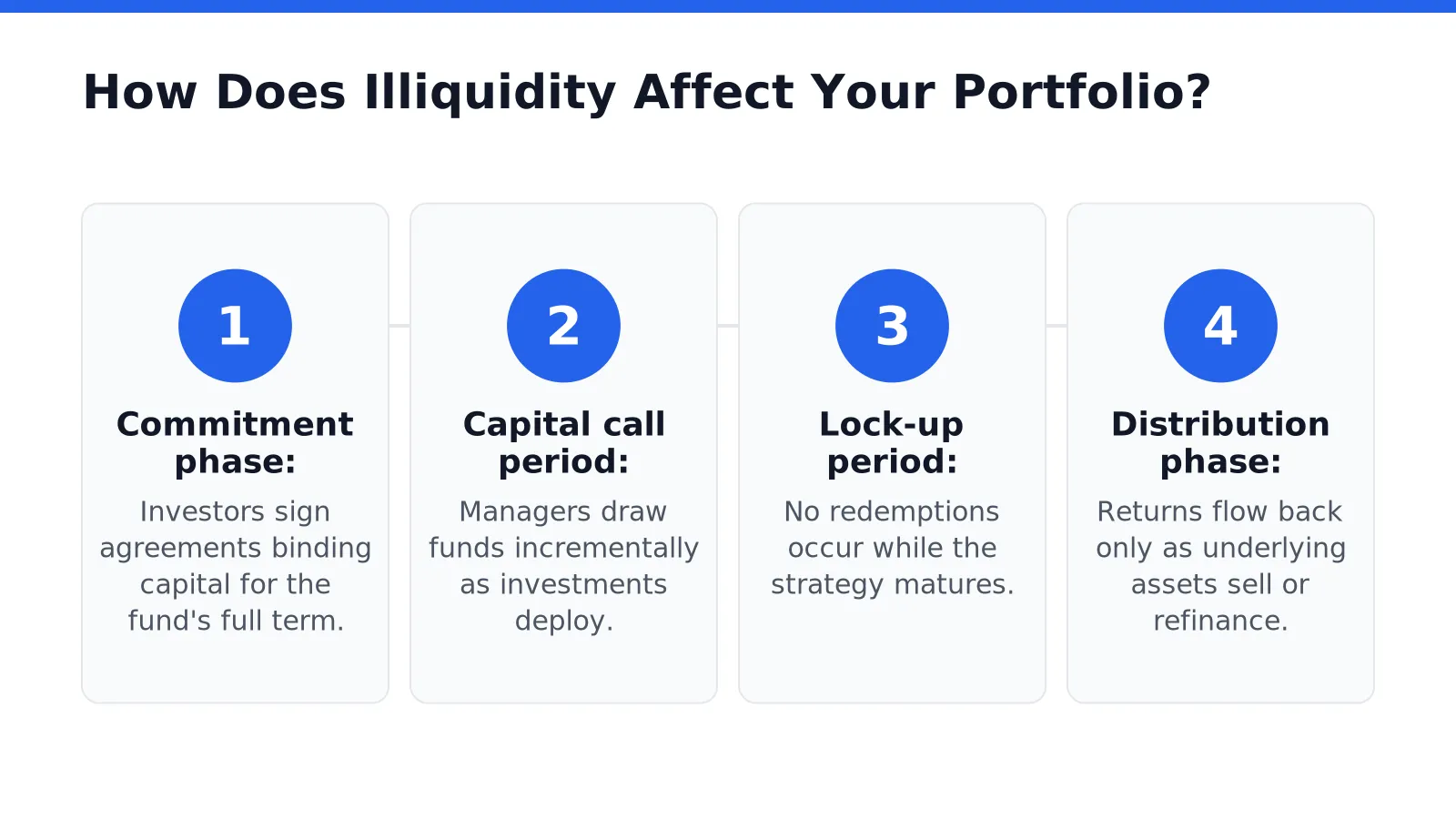
How Does Illiquidity Affect Your Portfolio?
Illiquidity means capital stays locked for extended periods. Alternative investments carry different timelines and risk profiles compared to public stock exchanges, including limited liquidity. Investors who overlook this constraint face forced sales at steep discounts or complete inability to access funds during emergencies.
What risks should I be aware of when investing in alternative assets? The primary concern is illiquidity risk in private equity and the mismatch between investment horizons and cash needs. Private equity and private credit typically lock up capital for years, not days. A public stock sells in seconds. A private fund redemption may take quarters.
What Happens When Capital Is Locked Up?
The consequences unfold in predictable stages:
1️⃣ Commitment phase: Investors sign agreements binding capital for the fund’s full term.
2️⃣ Capital call period: Managers draw funds incrementally as investments deploy.
3️⃣ Lock-up period: No redemptions occur while the strategy matures.
4️⃣ Distribution phase: Returns flow back only as underlying assets sell or refinance.
Each stage removes control from the investor. Missed capital calls trigger penalties or forfeiture of prior contributions.
How Do Real Estate Structures Manage Illiquidity?
A Delaware Statutory Trust offers fractional ownership in stabilized commercial property with defined investment structures and oversight. This structure provides some secondary market options, though liquidity remains far below public REITs. Investors gain access to multifamily housing, medical office space, and distribution facilities without direct management burdens.
The tradeoff is clear: alternative assets reward patience but punish forced exits. Sophisticated investors match illiquid allocations to capital they will not need for five to ten years.

Why Is Valuation Opacity a Concern?
Alternative investments exist outside of public markets. Valuations are not continuously updated by exchanges. This structural reality creates a fundamental challenge for accredited investors and high-net-worth individuals who depend on accurate pricing to measure performance, assess risk, and make allocation decisions. Without daily mark-to-market pricing, the true value of a private equity stake, a real estate syndication, or a venture capital position remains an estimate until a liquidity event occurs. That gap between estimated and realized value introduces uncertainty that compounds across a portfolio.
The scale of private markets magnifies this concern, a dynamic often described as valuation opacity private markets face as more capital moves outside exchanges. The number of private companies has grown substantially, meaning more assets sit outside transparent pricing mechanisms. Each additional holding without real-time valuation adds another layer of opacity to an investor’s net worth calculation. Portfolio-level risk assessment becomes less precise when large allocations rely on quarterly or annual appraisals rather than market-driven prices.
How Do Private Assets Get Valued Without Public Markets?
Private fund managers typically rely on appraisal-based methodologies. Third-party valuation firms assess comparable transactions, discounted cash flows, and industry multiples. These methods produce reasonable estimates but lack the immediacy of exchange-driven pricing. Investors receive updated values periodically, not continuously.
What Structures Provide Greater Valuation Transparency?
Certain investment vehicles offer more clarity than others. A Delaware Statutory Trust, for example, places a professional trust sponsor in charge of acquisition, financing, operations, and property management. This centralized oversight creates a defined reporting structure. Investors gain access to regular financial statements and property-level performance data. While still not exchange-traded, the DST framework reduces the information asymmetry common in direct private deals.
Investors who ignore valuation opacity risk misjudging their true financial position. A portfolio that appears stable on paper may carry hidden concentration or debt-related risks that only surface during market stress.
What Regulatory and Due Diligence Gaps Exist?
Alternative investments operate under lighter regulatory frameworks than public securities, which raises accredited investor portfolio risk. This structural difference places the burden of verification squarely on the investor. Publicly traded stocks and bonds face strict SEC oversight and standardized disclosure requirements. Private equity, private credit, and real estate syndications do not. Investors who skip deep due diligence risk capital loss from information asymmetry that no regulator will remedy.
Why Are Alternative Investments Less Regulated Than Public Securities?
Private offerings rely on accredited investor exemptions. Regulators assume qualified participants possess the sophistication to evaluate deals independently. The trade-off is access to opportunities unavailable in public markets. The cost is the absence of standardized reporting and mandatory transparency.
How Can Investors Close the Due Diligence Gap?
A systematic process replaces the missing regulatory safety net. Creative Capital Wealth Management Group deploys its Milestone Clarification Process and Wealth Charting methodology to create accountability for clients evaluating alternative assets. These tools map each investment against long-term objectives, tax implications, and liquidity needs. The firm’s retainer-based planning model provides access to accredited investments while ensuring only qualified investors participate. This gatekeeping function filters opportunities before they reach a client’s portfolio.
The due diligence framework examines several critical dimensions:
☑️ Sponsor track record and operational history across multiple market cycles
☑️ Fee structures, including management fees, carried interest, and hidden costs
☑️ Exit strategies and realistic liquidity timelines for each asset class
☑️ Legal documentation review for investor protections and governance rights
Investors who bypass these steps accept risks that public market participants never face. No regulatory body reviews private placement memoranda for completeness. No agency verifies performance claims. The gap between public and private market oversight demands a disciplined, repeatable evaluation process. Without it, accredited investors operate without the safeguards they take for granted in traditional securities.
How Can You Build a Risk-Managed Alternative Strategy?
A risk-managed alternative strategy starts with a structured, tax-aware, and goal-driven framework. Wealth investment strategies are not about chasing trends or timing markets. They are about designing capital to compound efficiently over time.
Creative Capital Wealth Management Group delivers retainer-based planning that never requires moving assets. Salaried Wealth Strategists back this approach, removing product-sales pressure from the advisory relationship.
What Are the Core Variables in a Risk-Managed Strategy?
Three variables separate average investing from strategic wealth management:
1️⃣ Tax efficiency: Structuring alternative holdings to minimize unnecessary tax drag across the portfolio.
2️⃣ Risk alignment: Matching each alternative asset’s risk profile to the investor’s specific goals and capacity for loss.
3️⃣ Behavioral discipline: Maintaining a predetermined framework despite market volatility or emotional impulses.
How Does Retainer-Based Planning Reduce Risk?
Retainer-based planning removes conflicts that distort risk decisions. Clients receive advice without pressure to move assets or purchase specific products. Salaried Wealth Strategists evaluate alternatives on merit alone, not commission potential. This structure keeps risk management aligned with client outcomes rather than advisor incentives.
What Risks Should Investors Watch in Alternative Assets?
Alternative assets carry illiquidity, valuation opacity, and concentration risk. A structured framework addresses these through deliberate allocation sizing and tax-aware placement. Without such discipline, investors lose capital to unnecessary tax leakage and misaligned risk exposure.
Frequently Asked Questions
What are the biggest risks of alternative investments?
Illiquidity locks capital for years, valuation is uncertain without daily pricing, and fewer disclosure requirements leave investors with less information than public markets provide.
How does illiquidity affect my portfolio?
Capital stays locked for years with no secondary market for early exits, and private equity and real estate syndications often require long-term commitments.
What role does due diligence play in managing these risks?
Thorough due diligence reduces information asymmetry between investors and sponsors by examining track records, fee structures, and alignment of interests before capital commitment.
Conclusion
Alternative asset risks demand a deliberate response, not passive acceptance. Illiquidity, valuation opacity, and lighter regulation require a disciplined framework that maps each opportunity against tax implications, liquidity needs, and long-term objectives. Investors who commit to systematic due diligence and structured allocation sizing convert these risks into managed variables. The next step is evaluating every alternative through a documented process that filters opportunities before capital commitment, ensuring each position serves the portfolio’s broader purpose rather than undermining it.