

What Are the Fees Associated With a DST 1031 Exchange Through Your Firm? DST 1031 exchange fees typically include acquisition costs, annual asset management fees, and disposition fees upon sale. These Delaware Statutory Trust costs vary by sponsor and property, and they sit alongside the 1031 exchange replacement property costs an investor weighs before reinvesting proceeds. Creative Capital Wealth Management Group advises clients to evaluate passive real estate 1031 fees alongside sponsor quality and projected returns, not in isolation.
Key Takeaways
DST 1031 exchange fees include acquisition costs, annual asset management fees, and disposition fees upon sale.
Acquisition costs reduce first-year net yield significantly.
Annual asset management fees reduce net distributions during ownership.
Disposition fees and profit-sharing arrangements at sale affect final proceeds to the investor.

What Are DST 1031 Exchange Fees?
Delaware Statutory Trust (DST) 1031 exchange fees span three distinct phases of the investment lifecycle. Costs emerge at acquisition, recur during the ownership period, and surface again when the property eventually sells. Investors who focus on a single percentage miss the full picture.
A DST acquisition typically carries DST upfront load fees. These include offering and organization expenses, broker-dealer commissions, and sponsor acquisition fees, collectively the DST sponsor fees that fund the offering’s formation and placement. During the holding period, ongoing asset management fees, property-level operating costs, and administrative expenses reduce net distributions. At exit, disposition fees and potential profit-sharing arrangements with the sponsor affect final proceeds. GCA 1031 Exchange Real Estate notes that a DST has costs at acquisition, costs during the ownership period, and costs when the property eventually sells.
Why shouldn’t investors evaluate a DST on fees alone?
Fees tell only part of the story. GCA 1031 Exchange Real Estate emphasizes that fees should be reviewed alongside the quality of the real estate, the sponsor, financing, projected income, and potential exit. A low-fee investment is not automatically a good investment. Higher fees should never be ignored because a projected return looks attractive.
The sponsor’s track record, property location, tenant quality, and debt structure and loan terms all carry weight in this assessment. An investor who selects the cheapest DST offering may sacrifice property quality, sponsor expertise, or income stability. The full context determines whether the fee structure aligns with the opportunity.
How does a retainer-based planning model change the fee conversation?
Creative Capital Wealth Management Group delivers retainer-based planning that never requires moving assets. This structure removes the incentive to recommend DST offerings based on commission size. The firm’s Wealth Strategists evaluate DST fees against the investor’s broader tax situation, legacy goals, and existing portfolio. A DST vs 1031 exchange comparison reveals how fee transparency differs across structures.
Fee analysis becomes part of a comprehensive wealth strategy rather than a standalone product decision. The retainer model aligns the evaluation process with the investor’s long-term outcomes, not a transaction.
What Are the Upfront Acquisition Costs?

Upfront acquisition costs in a Delaware Statutory Trust (DST) 1031 exchange include selling commissions and dealer manager fees. These charges appear before any rental income reaches the investor. A DST with an entry fee reduces first-year net yield significantly, often erasing most of the projected return in year one.
The fee structure matters because it directly competes with income. An investor reviewing a DST offering with a predicted yield and an entry fee faces a reduced first-year net position. That gap represents real capital lost before the property generates meaningful cash flow.
What Fees Appear at Acquisition?
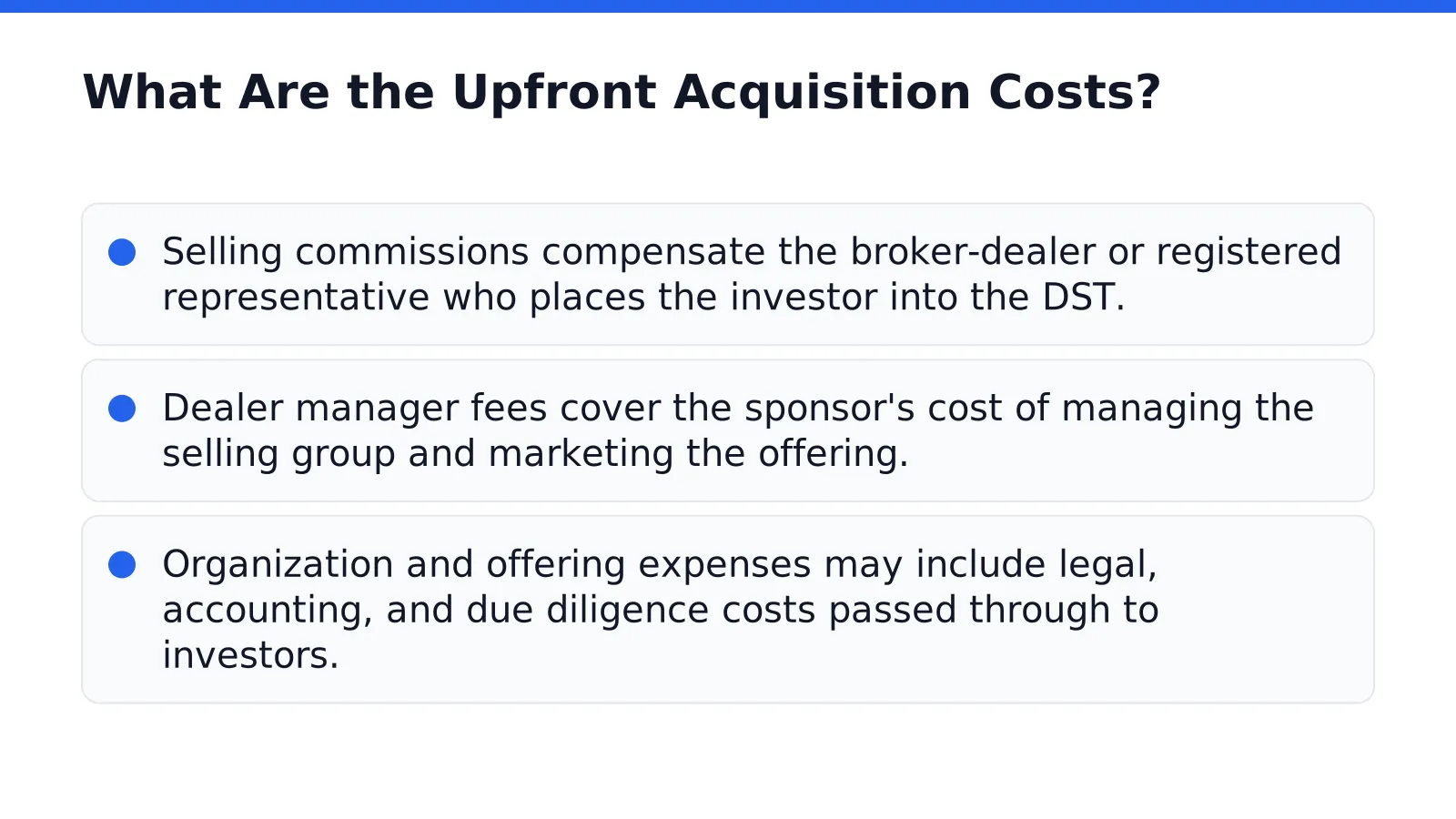
Selling commissions compensate the broker-dealer or registered representative who places the investor into the DST.
Dealer manager fees cover the sponsor’s cost of managing the selling group and marketing the offering.
Organization and offering expenses may include legal, accounting, and due diligence costs passed through to investors.
These costs are not always presented as a single line item. GCA 1031 Exchange Real Estate notes that a DST can have costs at acquisition, during ownership, and at eventual sale. Investors who focus only on the stated yield miss the full economic picture.
How Do Upfront Fees Affect the Investment Decision?
A low-fee DST is not automatically a better investment. The quality of the real estate, the sponsor’s track record, financing terms, and projected exit all influence long-term outcomes. Creative Capital Wealth Management Group’s salaried Wealth Strategists evaluate these variables without product sales conflicts, which helps clients weigh fees against asset quality.
DSTs offer fractional ownership in large-scale commercial properties with professional management. That structure appeals to accredited investors seeking passive replacement property. Yet the acquisition costs must be understood before committing capital. Investors who overlook DST risks may find the fee burden outweighs the tax deferral benefit.
What Ongoing Operational Fees Exist?

Ongoing operational fees cover the costs incurred during the ownership period of a Delaware Statutory Trust (DST) investment. A DST structure includes costs at acquisition, costs during the ownership period, and costs when the property eventually sells. The operational phase represents the middle stage where annual property management, administrative overhead, and sponsor oversight create recurring expenses that reduce net distributable cash flow to investors.
How Do Operational Fees Affect Monthly Distributions?
Monthly distribution amounts carry no guarantees. The sponsor deducts property-level operating expenses, asset management fees, and administrative costs before calculating investor payouts. A property facing unexpected maintenance issues or tenant vacancies may see distributions reduced or suspended entirely. Investors who overlook these structural deductions risk overestimating their passive income stream.
What Risks Accompany the Ownership Period?
Several risks emerge during the operational phase of a DST investment. DST 1031 exchange participants face illiquidity, loss of day-to-day control, and no guarantees for projected appreciation. The sponsor retains exclusive authority over property decisions, including refinancing, capital improvements, and timing of a sale. Investors cannot force liquidity or influence operational choices once the trust closes.
Creative Capital Wealth Management Group addresses these concerns through its Milestone Clarification Process. This structured review creates clarity and accountability by mapping each investment’s fee schedule against projected performance. The firm’s Virtual Family Office experience delivers transparent, flat quarterly fees, ensuring clients understand exactly what they pay for ongoing oversight without hidden charges layered into the investment structure.
What Are the Exit and Disposition Fees?

Exit and disposition fees represent the final layer of costs in a Delaware Statutory Trust investment. These charges surface when the DST property eventually sells. A DST carries costs at acquisition, during the ownership period, and at disposition, as noted by GCA 1031 Exchange Real Estate. Investors who overlook disposition costs risk eroding the very tax deferral benefits a 1031 exchange provides.
How Do Disposition Costs Affect the Net Proceeds?
Selling a DST-held property triggers transaction expenses that reduce the final distribution. These costs include brokerage commissions, legal fees, and sponsor disposition fees. The structure of a 1031 exchange defers capital gains taxes by reinvesting proceeds into like-kind real estate assets. Disposition fees reduce those reinvestable proceeds before the next exchange or cash-out occurs.
What Happens If the Property Sells at a Loss?
DST investments carry no guarantees for projected appreciation. The property could sell below the original purchase price. Illiquidity compounds this risk. Investors cannot exit early to avoid a declining market. Loss of principal remains a real possibility, and disposition fees still apply regardless of the sale outcome. A sponsor’s exit charge does not disappear because the investment underperforms.
Creative Capital Wealth Management Group structures its retainer-based planning without requiring clients to move assets. This approach reduces hidden friction that often accompanies bundled product sales. Transparent fee analysis becomes essential when evaluating any DST offering. Disposition costs deserve the same scrutiny as upfront loads and ongoing management charges.
How Does Creative Capital’s Model Compare?

Creative Capital Wealth Management Group operates on a retainer-based model. The firm’s salaried advisors provide advice free from product sales conflicts. This structure removes the incentive to recommend investments that generate commissions. A client’s fee arrangement remains transparent and flat, charged quarterly.
What makes the firm’s compensation structure different?
Most advisory models tie compensation to assets under management or product sales. Creative Capital’s approach separates the planning fee from investment selection. The company’s Wealth Charting process aligns taxes, investments, and legacy without pressure to move assets. Clients retain control over where their accounts are held.
How does the firm source alternative investments?
Deep relationships with alternative investment sponsors give clients access to accredited opportunities. These connections open doors to institutional-grade real estate, including Delaware Statutory Trust offerings. The firm’s leadership brings decades of collective experience in finance and technology to evaluating these sponsors. This background shapes a rigorous due diligence process that screens for quality before any recommendation reaches a client.
The firm’s frequently asked questions page details how this model supports long-term tax mitigation and legacy planning. Every recommendation flows from the client’s goals, not from a product quota.
Frequently Asked Questions
What are the three phases of DST 1031 exchange fees?
Acquisition costs, annual asset management fees, and disposition fees upon sale.
Why shouldn’t I evaluate a DST on fees alone?
Fees should be reviewed alongside sponsor quality, real estate quality, projected income, and potential exit.
How does Creative Capital Wealth Management Group’s retainer model affect fee analysis?
The retainer model removes the incentive to recommend DST offerings based on commission size, aligning evaluation with long-term outcomes.
Conclusion

A complete fee analysis across acquisition, operational, and disposition phases gives any investor the full picture before committing to a DST 1031 exchange. Reviewing sponsor quality, property fundamentals, and projected income alongside these costs clarifies whether the structure aligns with long-term goals. Investors who apply this disciplined framework position themselves to preserve tax deferral benefits and make decisions grounded in transparency rather than incomplete information.