

High-net-worth retirement income strategies prioritize tax-efficient withdrawal strategies, income diversification, and coordinated estate planning. Complex assets like real estate, business interests, and concentrated equity require structured frameworks. Creative Capital Wealth Management Group’s retainer-based planning aligns taxes, investments, and legacy without product sales conflicts, offering transparent flat quarterly fees and a Virtual Family Office experience for accredited investors.
Key Takeaways
Standard withdrawal models cannot accommodate the layered financial lives of affluent families with complex assets.
A market downturn early in retirement forces the sale of more concentrated equity shares to meet the same dollar withdrawal target.
A multi-bucket cash flow system organizes retirement assets into distinct pools based on tax treatment and withdrawal timing.
Why does the rule fall short for high-net-worth portfolios?
Standard withdrawal models cannot accommodate the layered financial lives of affluent families. Without a more tailored framework, investors risk depleting capital too quickly or triggering unnecessary tax liabilities that erode generational wealth.
High-net-worth individuals often face retirement planning decisions that involve complex assets, cross-disciplinary tax issues, and long-term family considerations. Real estate, business interests, and concentrated equity introduce challenges that standard retirement models do not address. A uniform withdrawal rate ignores the illiquidity of private holdings and the uneven cash flows these assets produce.
What makes high-net-worth retirement planning more complex than standard models?
Complexity arises from asset diversity and tax entanglement. Portfolios holding operating businesses, rental properties, or large single-stock positions behave differently than a simple stock-and-bond mix. Illiquid real estate cannot be liquidated in precise annual increments without transaction costs and market timing risks.
How do concentrated positions undermine the withdrawal strategy?
A market downturn early in retirement forces the sale of more shares to meet the same dollar withdrawal target. This accelerates portfolio depletion in ways a diversified index model never contemplates. Business owners with wealth tied to a single enterprise face an even starker mismatch between the rule’s assumptions and their reality.
A successful retirement income planning strategy starts with mapping assets, liabilities, and future cash flow. Creative Capital Wealth Management Group structures this analysis through its Milestone Clarification Process, which coordinates taxes, investments, and legacy goals. The firm’s Wealth Charting methodology visualizes how income streams from multiple asset classes can be sequenced to reduce tax drag. For portfolios that include alternative investments, alternative investments retirement income relies on distribution schedules and liquidity constraints that demand a custom withdrawal plan rather than a fixed percentage rule. Retainer-based planning ensures the strategy adapts as asset values and family circumstances shift over a retirement spanning three decades or more.

How do you calculate your retirement income target accurately?
Calculating a retirement income target accurately begins with a clear projection of post-career spending needs. High-net-worth individuals face unique complexity because standard replacement-rate formulas often miss the impact of concentrated equity, real estate holdings, and business interests. A precise target prevents the erosion of purchasing power over a retirement that may span three decades or longer.
What is the simplest method to estimate a retirement income need?
One approach multiplies estimated first-year portfolio withdrawal needs by 25. Comparing that target to current liquid savings provides an estimate of whether an asset gap exists. A surplus over that number signals a strong starting position.
A second method uses a percentage of current income as a baseline for a quick sanity check before deeper analysis. This percentage-based shortcut offers a quick sanity check before deeper analysis.
Why do standard formulas fall short for complex portfolios?
Standard formulas assume steady wage income and predictable expenses. Affluent investors often hold illiquid assets, deferred compensation, and multi-state tax exposure that simple multipliers cannot capture. Without adjusting for these variables, a retirement income target risks understating tax drag and overstating accessible cash flow.
Retirement Income Planning Strategies that incorporate tax-aware withdrawal sequencing and alternative investment income produce more durable projections. Creative Capital Wealth Management Group integrates these factors through its Milestone Clarification Process, aligning income targets with actual asset composition rather than generic assumptions. A comprehensive retirement planning framework connects the income calculation to estate goals and legacy priorities.
Method
Calculation
Best Use Case
25x First-Year Income
Sum expected income sources × 25
Quick minimum-need estimate
Precision matters because a miscalculation compounds across decades. The cost of that gap is unrecovered purchasing power and constrained legacy capacity.

What is a multi-bucket cash flow strategy and why does it matter?
Without strategic account segmentation, high-net-worth investors face unnecessary tax erosion that shrinks their effective retirement income.
The core structure relies on three account types working in concert. Tax-deferred accounts compound without annual tax drag. Tax-free accounts, such as Roth IRAs, deliver income with zero tax liability. Taxable accounts provide liquidity and favorable capital gains treatment. Combining all three creates flexibility that a single-account strategy cannot match.
Failing to segment assets surrenders control over a household’s marginal tax bracket each year. Taxes then consume returns that disciplined sequencing would preserve.
How do tax-deferred, tax-free, and taxable accounts work together?
Each account type serves a distinct tactical role. Tax-deferred vehicles hold assets best left untouched for decades. Tax-free accounts shelter the highest-growth investments, since gains escape taxation entirely. Taxable accounts fund near-term spending and opportunistic rebalancing without triggering early-withdrawal penalties.
Withdrawal sequencing determines the net result, and HNW retirement asset location decisions shape which account absorbs each year’s tax burden. Drawing from taxable accounts first allows tax-deferred balances to keep compounding. Tapping tax-free assets during high-income years avoids bracket creep. This choreography, grounded in Retirement Income Planning Strategies, turns tax diversification from a theory into a measurable edge.
Why does withdrawal sequencing matter for high-net-worth portfolios?
The order of withdrawals directly affects Medicare surcharges and total tax owed. A haphazard sequence pushes a retiree into higher brackets unnecessarily. Proper sequencing manages both immediate liability and long-term compounding.
Creative Capital Wealth Management Group integrates this framework into structured, tax-aware planning. Their approach ties cash-flow design to a larger set of best wealth management strategies for retirement, ensuring bucket allocation aligns with lifetime goals rather than arbitrary rules.
How does this approach support sustained compounding?
A multi-bucket design protects capital from premature liquidation. Tax-deferred pools continue growing while spending draws from other sources. Roth assets remain untouched until their compounding advantage reaches full maturity.
The result is a goal-driven framework where each dollar occupies the account best suited to its timeline and tax impact. Disciplined execution preserves wealth across decades, not just the first few years of retirement.
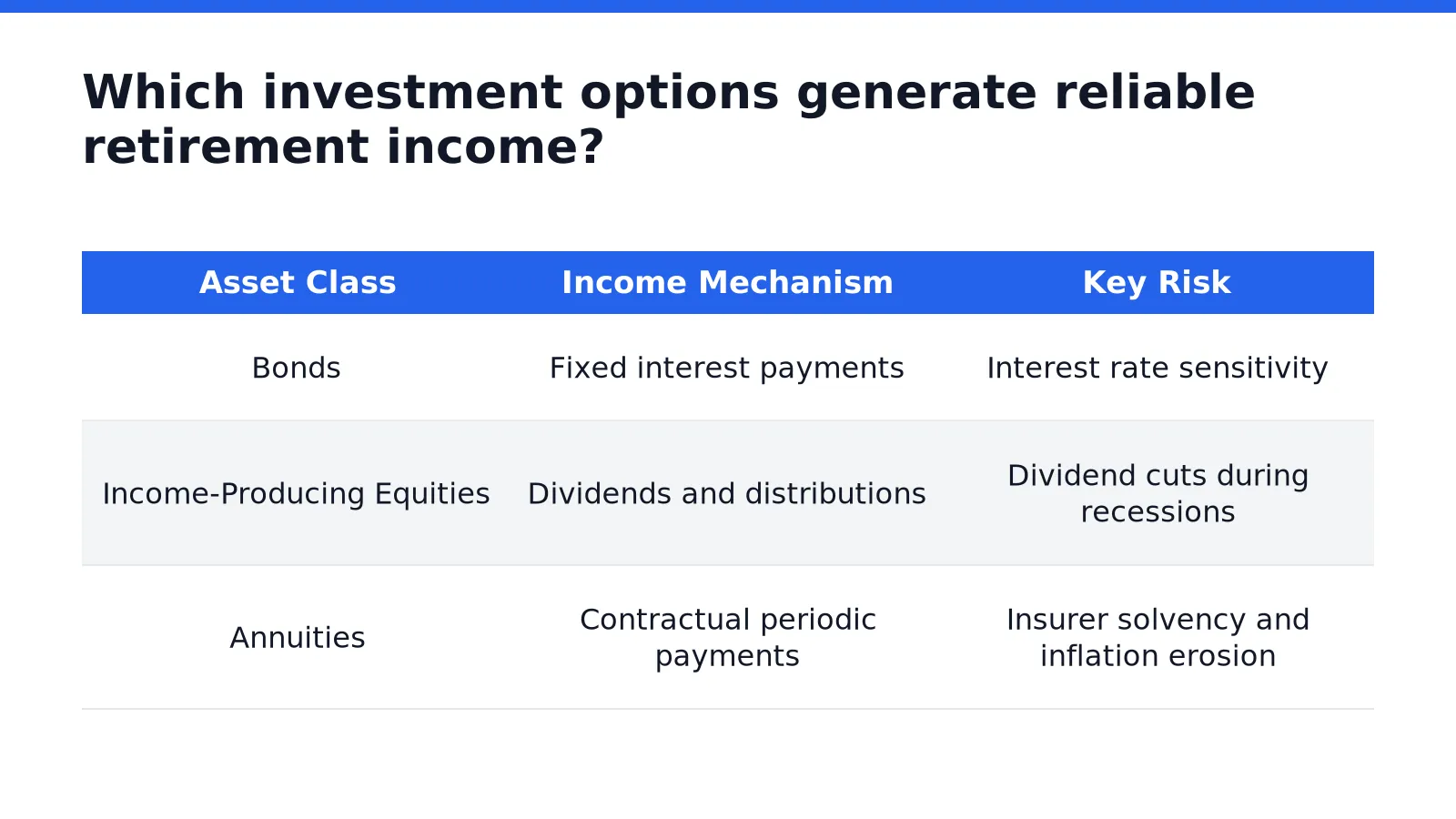
Which investment options generate reliable retirement income?
Reliable retirement income flows from a deliberate mix of bonds, annuities, and income-producing equities. These three asset classes supplement Social Security, pensions, and personal savings to create predictable cash flow. Without a structured income strategy, high-net-worth individuals risk drawing down principal too quickly during market downturns. That sequence-of-returns risk destroys portfolios that took decades to build.
Retirement Income Planning Strategies demand more than simple yield chasing. A portfolio concentrated entirely in growth stocks offers no buffer when valuations contract. Bonds provide contractual interest payments that arrive regardless of market conditions. Income-producing equities, such as dividend-paying stocks and real estate investment trusts, deliver quarterly distributions that often grow over time. Annuities convert a lump sum into a guaranteed income stream, transferring longevity risk to an insurance carrier.
How do bonds generate steady retirement income?
Bonds pay interest on a fixed schedule, typically semiannually. Treasury bonds, municipal bonds, and investment-grade corporates each carry different tax implications and credit risks. A laddered bond portfolio staggers maturities so principal returns at regular intervals, funding near-term expenses without forced asset sales.
What role do annuities play in retirement planning?
Annuities offer contractual guarantees that neither stocks nor bonds can replicate. An immediate annuity begins paying income shortly after purchase, while a deferred annuity accumulates value before converting to a payout stream. The trade-off involves liquidity: annuitized assets generally cannot be reclaimed as a lump sum.
Asset Class
Income Mechanism
Key Risk
Bonds
Fixed interest payments
Interest rate sensitivity
Income-Producing Equities
Dividends and distributions
Dividend cuts during recessions
Annuities
Contractual periodic payments
Insurer solvency and inflation erosion
Longer life expectancies mean retirement savings may need to last 20 to 30 years or longer, according to U.S. Bank. That extended horizon makes income durability essential.
A financial professional helps determine the most appropriate retirement income strategy for individual circumstances. The right mix depends on tax bracket, estate goals, and existing guaranteed income sources. Creative Capital Wealth Management Group evaluates these variables through a structured planning process that aligns investment selection with each client’s cash flow requirements.
How do you choose a retirement income strategy and advisor?
Selecting a retirement income strategy begins with matching a sophisticated financial structure to multi-asset portfolios. High-net-worth individuals seek investment strategies that reflect their sophisticated financial goals and risk tolerance. Without this alignment, affluent investors risk outliving their assets or losing purchasing power to tax inefficiency over a 25-year retirement horizon.
Creative Capital Wealth Management Group delivers retainer-based planning that never requires moving assets. This independence frees clients from product-sales pressure. The firm’s Retirement Income Planning Strategies unfold through its Milestone Clarification Process and proprietary Wealth Charting. These tools create accountability while aligning taxes, investments, and legacy objectives under one coordinated plan. Advisors who lack this integrated approach leave gaps between estate documents, tax filings, and portfolio allocations.
What separates a true retirement income advisor from a general financial planner?
A retirement income specialist designs decumulation sequencing, not just accumulation growth. Standard planners often stop at asset allocation. The firm provides a Virtual Family Office experience with transparent, flat quarterly fees and the option for fully virtual collaboration nationwide. Clients gain access to accredited alternative opportunities without custody requirements.
How do fee structures affect retirement income planning outcomes?
A transparent fee model removes incentives that distort withdrawal recommendations. Commission-based advisors profit when clients move money into certain products. Retainer-based compensation aligns the advisor’s interest entirely with plan performance. Flat quarterly fees let clients evaluate the relationship purely on strategic value. This structure supports objective decisions about retirement planning services and income timing.
Fee opacity compounds portfolio erosion in ways many investors never quantify. Flat-fee models eliminate this silent drag.
How can estate planning align with your retirement income strategy?
Estate planning and retirement income planning are not separate disciplines. They form a single, integrated framework that protects wealth across a lifetime and beyond. Without coordination, high-net-worth individuals risk unnecessary tax erosion and fragmented asset transfers that undermine decades of accumulation.
Retirement Income Planning Strategies succeed when estate documents and income distributions work in concert. A retirement withdrawal sequence that ignores trust structures or beneficiary designations creates gaps. Those gaps trigger probate delays, forced asset sales, and tax liabilities that diminish the legacy intended for heirs.
What estate planning documents directly affect retirement income?
Several instruments shape how retirement assets flow during life and after death. A revocable living trust holds assets and directs their distribution without court involvement. Beneficiary designations on IRAs and qualified plans override will provisions, making periodic reviews essential. Powers of attorney ensure continuity if incapacity interrupts income management.
How do tax considerations link estate plans to retirement withdrawals?
Tax-efficient withdrawal sequencing preserves more capital for both retirement spending and wealth transfer. Drawing from taxable accounts first allows tax-deferred accounts to compound longer. This approach reduces the estate’s overall tax footprint. Establishing effective estate management strategies becomes crucial to ensure wealth preservation and avoid unnecessary tax burdens as families accumulate assets across generations.
Coordinating these elements requires looking beyond account balances. Trust funding, gifting strategies, and charitable remainder trusts each alter the tax profile of retirement income. Families better navigate the intricacies of estate management and secure their financial legacy for future generations by understanding key strategies. Retirement planning is a crucial aspect of financial security that many individuals overlook until it is too late. The cost of that oversight compounds when estate plans remain disconnected from income realities.
FAQ
Why does the rule fail for high-net-worth portfolios?
It assumes a simplified, single-asset-class retirement. Standard withdrawal models cannot accommodate the layered financial lives of affluent families, risking capital depletion or unnecessary tax liabilities that erode generational wealth.
What framework does Creative Capital Wealth Management Group use for retirement income planning?
The firm uses its Milestone Clarification Process and Wealth Charting methodology to sequence income streams from multiple asset classes, reducing tax drag. It offers retainer-based planning with transparent flat quarterly fees and a Virtual Family Office experience.
Conclusion
Selecting a retirement income strategy demands an advisor who structures decumulation sequencing, not just portfolio growth. A transparent, retainer-based model removes product-sales pressure and aligns every recommendation with your cash flow needs. The right framework coordinates estate documents, tax positioning, and withdrawal timing under one plan. That integration protects your purchasing power and legacy across a 25-year retirement horizon.