

Alternative investment management strategies for wealth preservation focus on non-correlated assets like private equity, real estate, and structured notes to reduce portfolio volatility. Creative Capital Wealth Management Group employs a Milestone Clarification Process and Wealth Charting to align these alternatives with tax-efficient, goal-driven frameworks. How to Manage Alternative Investments creates clarity and accountability for accredited investors seeking capital protection.
Key Takeaways

Alternative investments like private equity and real estate reduce correlation to public markets during stressed periods.
Private debt generates contractual cash flows independent of stock market swings, shielding capital when public markets decline.
Real assets including infrastructure and tangible property provide inflation-responsive returns linked to economic activity.
A current financial plan and fully funded emergency fund form the non-negotiable foundation before moving capital into less liquid vehicles.
Why consider alternative investments for wealth preservation?
Alternative investments strengthen wealth preservation by delivering non-correlated returns that cushion portfolios during market turbulence. Traditional stock and bond allocations often move in tandem when volatility spikes, leaving concentrated portfolios exposed to sharp drawdowns that erode years of compounding.
Wealth preservation matters most when markets feel unsettled and costs keep rising. Without diversification into asset classes that behave differently from public equities, a portfolio carries the risk of amplified losses precisely when capital stability is needed. Citigroup’s Private Bank research found that alternative assets including private equity, real estate, and hedge funds historically reduced correlation to public markets during stressed periods.
What makes alternative investments effective for protecting wealth?
Alternative investments operate outside the daily liquidity and sentiment swings of public exchanges. Private credit and real assets can be evaluated using a structured process to align with your financial goals.
How does tax-aware structuring support wealth preservation?
A structured, tax-aware, and goal-driven framework allows capital to compound efficiently over time. Advisors deploying private placement vehicles and qualified opportunity zone strategies can defer or reduce recognition events. This preserves more working capital inside the portfolio.
What role does a defined process play in accessing alternatives?
Accredited investor alternative investments require due diligence and clarity before capital is committed. A structured process brings accountability to evaluating sponsors, fee structures, and liquidity terms. Effective wealth management investment strategies pair rigorous manager selection with ongoing monitoring to match the investor’s liquidity profile and risk tolerance.
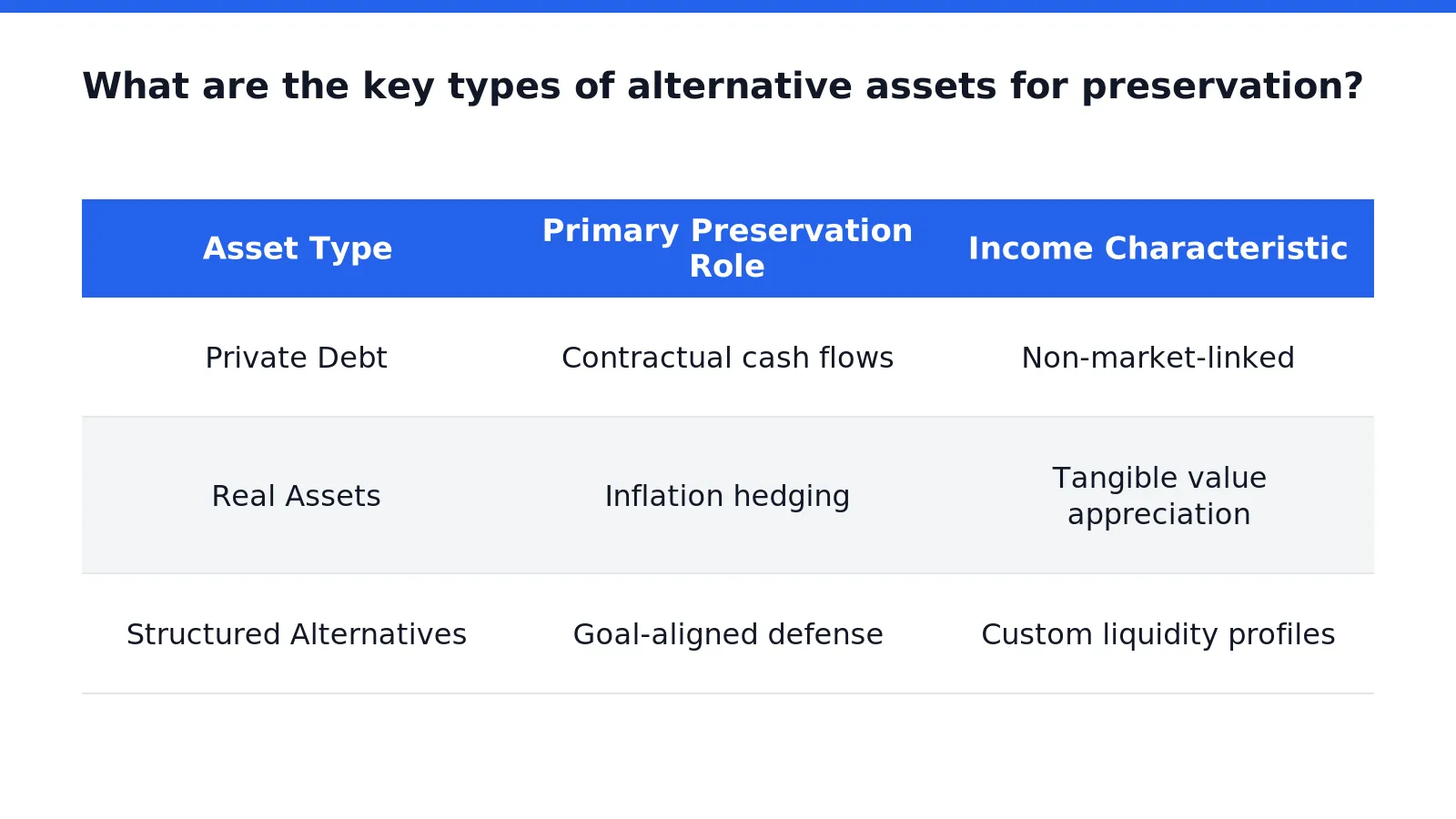
What are the key types of alternative assets for preservation?
Alternative assets for preservation fall into three primary categories: private debt, real assets, and structured alternatives. These vehicles generate non-market income and protect generational capital from public-market volatility. Without uncorrelated holdings, a portfolio absorbs every equity downturn without a buffer.
How to Manage Alternative Investments begins with understanding what each category contributes. Private debt offers contractual cash flows independent of stock market swings. Real assets, including infrastructure and tangible property, provide inflation-responsive returns. Structured alternatives align investments with personal goals and liquidity needs, creating a defense against capital erosion.
What makes private debt a preservation tool?
Private debt investments generate income streams that do not depend on equity market performance. Lenders receive contractual payments regardless of whether the S&P 500 rises or falls. This detachment shields capital when public markets decline. Creative Capital Wealth Management Group maintains deep relationships with alternative investment sponsors to provide access to these accredited opportunities.
How do real assets protect against inflation?
Real assets hold intrinsic value that rises with the cost of goods and services, making them an effective real assets inflation hedge. Infrastructure projects, natural resources, and commercial property produce returns linked to economic activity rather than market sentiment. Portfolio diversification stands as a core strategy for wealth preservation, according to U.S. Bank’s wealth preservation guidance. A mix of real assets and traditional holdings reduces correlation risk across market cycles.
Asset Type
Primary Preservation Role
Income Characteristic
Private Debt
Contractual cash flows
Non-market-linked
Real Assets
Inflation hedging
Tangible value appreciation
Structured Alternatives
Goal-aligned defense
Custom liquidity profiles
High-net-worth capital preservation relies on uncorrelated alternative assets to insulate wealth from sequence-of-return risk. The trade-off involves reduced liquidity, which often enables the very strategies that deliver non-correlated returns. Investors who accept this structure gain access to opportunities that public markets cannot replicate.
Why does goal alignment matter in alternative selection?
Alternatives work best when matched to specific financial objectives rather than generic benchmarks. Aligning investments with personal goals and liquidity needs prevents mismatches that force untimely exits. A preservation-focused allocation looks different from a growth-oriented one. The structure must reflect the investor’s timeline, tax situation, and legacy intentions.

How to manage alternative investments within a preservation plan?
Managing alternative investments inside a wealth preservation framework demands a structured, multi-layered approach. A current financial plan and a fully funded emergency fund form the non-negotiable foundation before any capital moves into less liquid vehicles. Without that base, an investor risks forced liquidation of illiquid positions during market stress, destroying the very preservation the strategy was meant to deliver.
What role does tax-aware planning play in alternative investment management?
Tax efficiency separates successful alternative investment programs from costly ones. How to manage alternative investments effectively requires integrating tax-aware planning and estate planning from the first allocation decision. Strategies that defer or minimize tax drag preserve more capital for compounding. Estate planning ensures those assets transfer according to the investor’s wishes rather than default state law.
How does portfolio construction change when alternatives enter a preservation plan?
Diversification remains the core risk management tool. Alternatives serve as non-correlated sleeves that buffer public market volatility. The allocation must align with liquidity needs, time horizon, and the investor’s capacity to tolerate complexity. Regular check-ins with financial, tax, and legal professionals keep the strategy aligned with evolving goals. A static allocation drifts; a reviewed allocation adapts.
Creative Capital Wealth Management Group structures its engagements around retainer-based planning that never requires moving assets. This preserves client control while delivering coordinated oversight. The firm’s approach connects investment decisions with effective tax strategies that protect wealth across market cycles. Flat quarterly fees remove product-sale conflicts from the relationship. The result is a preservation plan where alternatives serve the portfolio rather than dominating it.

What criteria should guide your choice of alternative manager?

Selecting an alternative investment manager demands scrutiny of fee transparency, process clarity, and alignment of incentives. A manager who obscures costs or pushes proprietary products creates risk that erodes returns before performance is even measured.
How to Manage Alternative Investments begins with evaluating whether the manager’s compensation model creates conflicts. Creative Capital Wealth Management Group operates on transparent, flat quarterly fees with no product sales conflicts. That structure removes the incentive to recommend vehicles that generate commissions rather than outcomes.
What role does fee transparency play in manager selection?
Transparency in financial planning fees builds trust with high-net-worth clients. A manager who cannot explain every charge in plain language fails the first test of fiduciary responsibility. Hidden costs compound silently, reducing long-term wealth accumulation.
How does a Virtual Family Office model change manager evaluation?
A Virtual Family Office experience provides access to sophisticated strategies without asset custody requirements. Clients retain control of their accounts while receiving institutional-grade oversight. This arrangement eliminates the pressure to move assets as a condition of receiving advice.
Wealth preservation strategies extend beyond portfolio construction. Insurance and estate planning protect assets across generations, and a qualified alternative manager coordinates these elements rather than treating them as afterthoughts. The right manager integrates tax-aware planning, risk alignment, and legacy objectives into a single framework.
Creative Capital’s approach to financial services emphasizes independent diagnosis before any recommendation. No products to push. No accounts to move. Just a structured process that evaluates whether alternative investments fit a client’s broader wealth strategy.
How does Creative Capital support alternative investment management?

Creative Capital Wealth Management Group structures alternative investment oversight through a conflict-free advisory model. Salaried Wealth Strategists deliver guidance untethered from product sales incentives, a distinction that reshapes how accredited investors evaluate and monitor non-correlated assets.
What makes Creative Capital’s approach to alternatives different?
Most advisory relationships tie compensation to asset movement or transaction volume. Creative Capital separates advice from product distribution entirely. The firm’s Wealth Strategists receive salaries, not commissions. This structure removes the pressure to recommend alternatives that generate fees rather than fit the portfolio. Investors gain analysis rooted in suitability, not sales quotas.
How does the firm create accountability around alternative holdings?
Two proprietary frameworks anchor the oversight process. The Milestone Clarification Process maps each alternative position to a specific financial objective, timeline, and liquidity requirement. Wealth Charting then visualizes how those holdings interact with taxes, concentrated positions, and estate structures. Together, these tools produce a documented rationale for every allocation. Clients see exactly why an alternative earns its place and under what conditions the position should exit.
The retainer-based engagement preserves asset location independence. Investors maintain custody of their holdings at existing institutions while Creative Capital coordinates strategy across accounts. Transparent access to the financial plan and advisory team remains available at all times, a structure the firm details in its frequently asked questions resource. This continuity matters when alternatives carry lock-up periods or limited redemption windows. No forced consolidation disrupts existing banking or custody relationships.
What ongoing support do alternative investors receive?
Monitoring extends beyond quarterly statements. The Wealth Strategist team tracks manager performance, fee structures, and strategy drift against the benchmarks established during the Milestone Clarification Process. When tax-loss harvesting opportunities arise or capital calls approach, the firm coordinates timing with the client’s CPA and estate attorney. This integrated oversight prevents alternatives from becoming orphaned positions that no single advisor fully owns.
Frequently Asked Questions
Why consider alternative investments for wealth preservation?
Alternative investments deliver non-correlated returns that cushion portfolios during market turbulence, reducing exposure to sharp drawdowns that erode compounding.
How do alternative investments align with financial goals?
Private credit and real assets align with financial goals through the Milestone Clarification Process.
What role does a defined process play in accessing alternatives?
A defined process brings accountability to evaluating sponsors, fee structures, and liquidity terms.
Conclusion

Alternative investments preserve wealth when they serve a documented purpose within a broader strategy. The decision to allocate requires a manager who evaluates suitability before recommending a vehicle, monitors performance against stated objectives, and coordinates with tax and estate professionals. Selecting that manager demands scrutiny of fee transparency and incentive alignment. A conflict-free structure removes the pressure to recommend alternatives that generate commissions rather than fit the portfolio.