
Venture capital – investing in early-stage, high-growth private companies through a pooled fund – has historically been reserved for institutions and ultra-wealthy individuals with direct access to top-tier funds, but it is now a defined component of institutional-style household portfolios such as CCWMG’s Household Endowment Model. Understanding how venture capital actually works – the risk shape, the timeline, the way capital gets deployed – matters more than the appeal of “getting in early.” The following overview outlines what venture capital actually involves.
Key Takeaways
- Venture capital is a subset of private equity focused on early-stage, high-growth companies, with a meaningfully different risk profile than buyout-style private equity.
- Returns follow a “power law” – a small number of investments typically drive the large majority of a fund’s total gains.
- The “J-curve” means early losses are normal, not a warning sign, since fees and early-stage investments outweigh returns for the first several years.
- VC funds are “drawdown vehicles” – capital is committed upfront but actually called over several years, not invested all at once.
- Access typically requires accreditation – contact Creative Capital Wealth Management Group for the specific eligibility criteria that apply to a given fund.
- The Creative Capital Household Endowment Model (CCHEM) includes venture capital as one of several non-correlated asset classes, not a standalone bet.
What Is Venture Capital, and How Is It Different From Other Private Equity?
When comparing venture capital vs private equity, the two are often grouped together, but the underlying investments and risk profile look quite different.
What Makes Venture-Stage Companies Different From Buyout Targets?
Venture capital funds invest equity – not debt – into young, high-growth companies still working toward profitability, while traditional private equity buyout funds typically target mature, cash-generating companies acquired using significant debt financing. This distinction shapes everything else about how the two strategies behave, from risk to timeline to how returns are actually generated.
Why Does Venture Capital Carry a Different Risk Shape Than Other Private Equity?
Because venture-stage companies are inherently unproven, many of any given fund’s investments will underperform or fail entirely, while buyout targets – already generating revenue – tend to have a narrower range of outcomes. This difference in risk shape is a defining, structural feature of venture investing, not an indication that something has gone wrong with a specific fund.
Why Do a Small Number of Investments Drive Almost All Venture Capital Returns?
Understanding this pattern changes how a rational investor should think about any single company in a fund’s portfolio.
What Is the “Power Law” of Venture Returns?
Venture capital returns are widely documented to follow a “power law” distribution, where most individual investments in a fund return less than the capital put into them, while a small number of outsized winners generate the large majority of the fund’s total gains. This is not a flaw in how funds are selected – it is a structural characteristic of investing in unproven, high-growth companies, where most attempts do not succeed but a few succeed enormously.
What Does This Mean for How a VC Allocation Should Be Sized?
Because outcomes are concentrated in relatively few winners, diversification across multiple funds, vintages, and managers matters more in venture investing than it might in more predictable asset classes – a single fund’s results can vary enormously based on whether it happened to land one of the rare big winners. This is part of why venture exposure is typically sized as a portion of a broader diversified strategy, not a concentrated, standalone bet.
What Is the Venture Capital J-Curve, and Why Does It Matter for Investor Expectations?
This is one of the most commonly misunderstood aspects of venture capital investing, especially for newer investors.
Why Do VC Funds Typically Show Losses in Their Early Years?
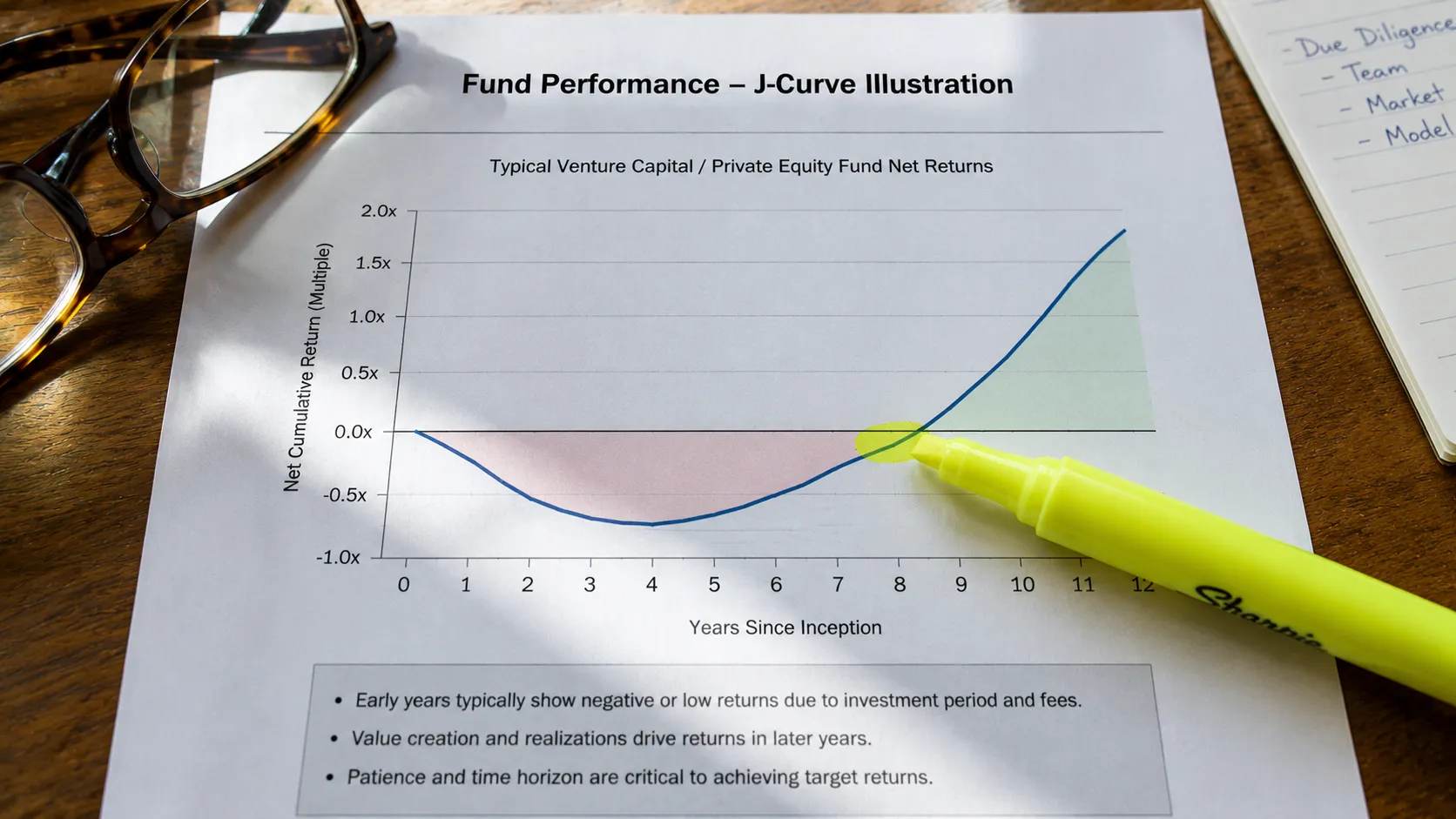
The “J-curve” describes the typical performance pattern of a venture fund: an initial period of negative or flat returns – often lasting three to five years – as management fees and early-stage investments outweigh any realized gains, before performance turns upward as portfolio companies mature and exit. A recent industry analysis found that more than 60% of VC funds from a single recent vintage year had not yet distributed any capital back to investors after five years – a normal part of the pattern, not a sign of underperformance.
When Do Distributions Actually Start Coming Back?
Distributions typically begin picking up as the fund enters its later years, often five to seven years in, as portfolio companies reach acquisition or IPO exits and begin returning capital to investors. This is exactly why venture capital requires patience measured in years, not quarters – judging a fund’s success based on early performance metrics alone can be genuinely misleading.
How Does Capital Actually Get Called and Invested Over Time?
Unlike a typical stock purchase, committing to a VC fund does not mean writing one check that gets fully invested immediately.
What Does It Mean That a Venture Capital Drawdown Vehicle Calls Capital Over Time?
VC funds are structured as drawdown vehicles, meaning investors commit a total amount upfront but the fund manager only calls that capital gradually over roughly four to six years as specific investment opportunities arise, often with only a few weeks’ notice for each capital call. This structure requires investors to keep committed but uncalled capital genuinely accessible, since calls can happen on a compressed timeline.
How Long Is Committed Capital Actually Locked Up?
Once called, venture capital is typically illiquid for the full life of the fund – commonly 10 to 12 years or longer – meaning this is capital that needs to be genuinely unnecessary for a decade or more, not just temporarily set aside. This is a much longer commitment horizon than most other alternative investments, and it is a consideration worth weighing honestly before committing.
Who Can Actually Access Venture Capital, and How?
Access to venture capital has historically been more restricted than many other alternative investment categories.
Accredited Investor Venture Capital Access: Is It Enough, or Is More Required?
Some venture capital fund structures are available to accredited investors, while others require the higher qualified purchaser standard for venture capital, depending on the specific fund’s legal exemption. This distinction matters, and eligibility criteria vary by fund – contact Creative Capital Wealth Management Group for information on which standard applies to any specific venture capital opportunity.
How Does CCWMG’s Household Endowment Model Incorporate Venture Capital?

The Creative Capital Household Endowment Model (CCHEM) incorporates venture capital alongside private equity, real estate, and natural resources as part of its broader non-correlated asset allocation. Minimums and terms vary by program – contact Creative Capital Wealth Management Group for general information. CCWMG considers alternatives based on a client’s goals and risk tolerance, rather than as a default component of every portfolio – venture capital exposure is included only when it genuinely fits a client’s specific objectives.
Frequently Asked Questions
Do I need to pick individual venture-backed startups to invest in VC? Not typically – most individual investors access venture capital through pooled funds managed by a general partner, rather than selecting individual companies directly, which is part of how diversification against the power-law return pattern is achieved.
Is venture capital riskier than other alternative investments like real estate? It carries a different kind of risk, not simply more risk – the power-law return pattern and longer illiquidity horizon are structurally different from real estate’s risk profile, which tends to be more income-driven and less binary in outcome.
Does Venture Capital Fit a Broader Wealth Strategy?
Venture capital’s appeal is easy to understand, but its risk shape, illiquidity, and access requirements are genuinely different from other alternative investments. Creative Capital Wealth Management Group can help investors think through whether it belongs in a specific portfolio, or whether a different asset class better serves the same goal.