

Delaware Statutory Trusts offer fractional ownership of institutional-grade properties, deferring capital gains without direct management burdens. Accredited investors seeking flexibility beyond rigid DST syndicates consider passive 1031 replacement property options such as tenant-in-common structures, opportunity zone funds, or private real estate funds. Creative Capital Wealth Management Group provides retainer-based planning, aligning tax-efficient exit strategies with long-term wealth objectives.
Key Takeaways
Section 721 UPREIT exchanges defer capital gains while converting real estate into liquid, diversified security.
Qualified Opportunity Funds defer capital gains by reinvesting proceeds into designated low-income communities.
Tenancy-in-common arrangements offer an alternative to DSTs with different management burdens and liquidity profiles.
The right alternative depends on desired involvement, sponsor risk tolerance, and liquidity needs.
What Are DST 1031 Exchange Alternatives?
A 1031 exchange defers capital gains, depreciation recapture, and other taxes when an investor reinvests net equity from a property sale into like-kind real estate. DST 1031 Exchange Alternatives are investment structures that accomplish this tax deferral without requiring direct ownership of an income property. Investors have multiple choices beyond the standard Delaware Statutory Trust arrangement.
What Structures Count as Alternatives to a DST?
A Delaware Statutory Trust is an investment vehicle used to hold commercial real estate assets for accredited investors. The DST structure offers fractional ownership in large-scale properties while professional managers handle operations. This removes tenant issues, capital calls, financing, and repair responsibilities from the investor. Weighing Delaware Statutory Trust pros and cons against other structures helps investors determine whether this passive ownership model fits their goals.
Alternatives include direct ownership of a replacement property, tenancy-in-common arrangements, and other pooled real estate vehicles. Each option carries different management burdens, liquidity profiles, and minimum investment thresholds.
Why Would an Accredited Investor Look Beyond a DST?
Rigid syndicate structures limit flexibility. Some investors want greater control over property selection or exit timing. Others prefer to avoid the sponsor dependency that comes with a DST. A comparison of DST versus 1031 exchange structures clarifies how management responsibilities and tax implications differ across approaches.
The right alternative depends on three factors:
1️⃣ Desired level of ongoing involvement
2️⃣ Tolerance for sponsor and property concentration risk
3️⃣ Need for liquidity or defined exit options
Creative Capital Wealth Management Group evaluates these trade-offs within a broader tax-aware wealth strategy. The firm’s retainer-based planning model aligns investment selection with each client’s legacy and income objectives, not with product sales incentives.
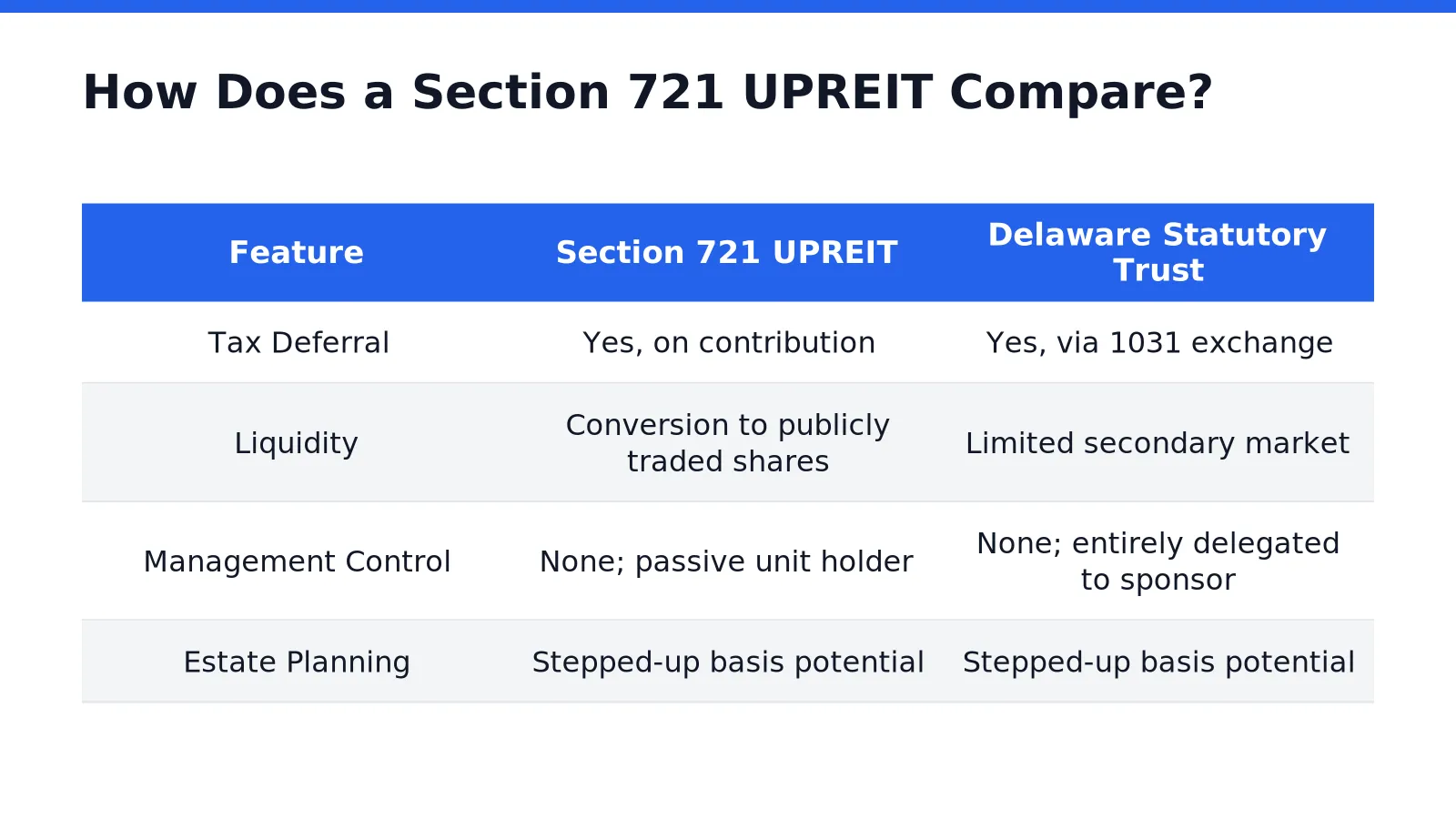
How Does a Section 721 UPREIT Compare?
A Section 721 UPREIT exchange converts real estate into operating partnership units in a real estate investment trust. The transaction defers capital gains taxes while shifting ownership from physical property to a liquid, diversified security. Investors who feel trapped on the 1031 exchange cycle often explore this exit path. The structure offers a fundamentally different risk and reward profile compared to direct ownership or Delaware Statutory Trust arrangements.
What Tax Advantages Does a UPREIT Provide?
The UPREIT structure defers capital gains and depreciation recapture taxes at the time of contribution. Property owners exchange their real estate for partnership units rather than cash, which avoids triggering an immediate taxable event. Estate planning benefits also emerge through this vehicle. Heirs may receive a stepped-up basis on the inherited units, potentially eliminating the deferred tax liability entirely.
How Does Control Differ From a DST?
Control represents the most significant trade-off in a UPREIT transaction. A Delaware Statutory Trust provides fractional ownership in large-scale properties while delegating all property-level decisions and asset management entirely to the sponsor. The UPREIT model goes further. Unit holders become passive limited partners in the operating partnership with no direct say in property-level decisions. Management authority consolidates entirely under the REIT’s executive team. For accredited real estate owners accustomed to hands-on control, this loss of influence demands careful consideration.
Feature
Section 721 UPREIT
Delaware Statutory Trust
Tax Deferral
Yes, on contribution
Yes, via 1031 exchange
Liquidity
Conversion to publicly traded shares
Limited secondary market
Management Control
None; passive unit holder
None; entirely delegated to sponsor
Estate Planning
Stepped-up basis potential
Stepped-up basis potential
What Happens to Liquidity Over Time?
Liquidity follows a staged timeline in a UPREIT structure. Operating partnership units typically convert into publicly traded REIT shares after a negotiated holding period. Once converted, those shares trade on public exchanges, offering a clear exit path unavailable in most private real estate vehicles. This eventual liquidity distinguishes the UPREIT from both direct property ownership and DST interests. The trade-off involves accepting near-term illiquidity during the lock-up period in exchange for long-term market access. Creative Capital Wealth Management Group helps clients evaluate whether this timeline aligns with their broader wealth investment strategies.

What Role Do Qualified Opportunity Funds Play?
Qualified Opportunity Funds (QOFs) serve as a tax-deferral vehicle distinct from traditional 1031 exchanges. A QOF allows investors to defer capital gains by reinvesting proceeds into designated low-income communities. The strategy unlocks a different set of tax benefits compared to direct property swaps.
A QOF investment triggers three potential tax advantages. First, the initial capital gain receives a deferral until the investment is sold or December 31, 2026. Second, holding the QOF interest for at least five years reduces the deferred gain by 10 percent. A seven-year hold increases that reduction to 15 percent. Third, and most compelling, a ten-year holding period eliminates all capital gains on the QOF investment itself. This step-up in basis rewards long-term commitment.
How Do QOFs Differ From 1031 Exchanges?
Comparing a qualified opportunity zone vs 1031 exchange highlights distinct diversification paths. QOFs provide diversification into non-real estate assets, while a traditional 1031 exchange locks an investor into another piece of real property. QOFs, by contrast, can hold operating businesses alongside real estate. This flexibility appeals to accredited investors seeking broader exposure without abandoning tax deferral.
What Is the Minimum Holding Period for Full Tax Benefits?
The full elimination of gains requires a ten-year holding period. Investors who exit earlier still capture partial benefits. The five-year and seven-year milestones reduce the original deferred gain. However, only the decade-long commitment wipes out taxes on the new investment’s appreciation. Creative Capital Wealth Management Group helps clients evaluate whether this timeline aligns with their liquidity needs and overall wealth investment strategies.
Are QOFs a Replacement for DST 1031 Exchange Alternatives?
QOFs complement rather than replace DST 1031 Exchange Alternatives. A Delaware Statutory Trust offers passive real estate ownership with immediate tax deferral under Section 1031. A QOF adds a different tool: community-focused investment with a back-loaded tax elimination feature. The choice hinges on an investor’s timeline, diversification goals, and appetite for development-zone risk. A detailed analysis of current QOF mechanics is available in Creative Capital’s guide on how a Qualified Opportunity Zone fund defers taxes.

How to Choose Between DSTs and Other Options?
Selecting the right 1031 exchange vehicle requires weighing control against convenience. DST 1031 Exchange Alternatives each carry distinct trade-offs in liquidity, management burden, and long-term estate alignment.
A Delaware Statutory Trust provides fractional ownership in stabilized commercial properties with professional management and no direct landlord duties. Investors gain exposure to multifamily housing, medical office space, and distribution facilities without tenant calls or capital calls. The trade-off is illiquidity. DST interests typically lock capital for years with limited secondary market access.
What Makes a TIC Different from a DST?
A tenant-in-common exchange offers direct co-ownership of real property. Investors hold titled deeds and exercise more control over asset decisions. That control comes with a cost. TIC structures require unanimous consent for major property actions and demand active involvement from every co-owner. For investors unwilling to manage property or coordinate with multiple partners, the burden outweighs the benefit.
How Do UPREITs Solve the Liquidity Problem?
Liquidity needs drive many investors away from DSTs entirely. UPREIT structures allow eventual conversion of operating partnership units into publicly traded REIT shares. An investor completes a Section 721 exchange into the operating partnership, then later converts units to liquid securities. The deferral remains intact through the initial exchange. This path suits those who prioritize eventual liquidity over current income stability.
Tax deferral strategies must also align with estate objectives. A stepped-up basis at death can eliminate deferred capital gains for heirs entirely. Creative Capital Wealth Management Group evaluates these alternatives through retainer-based planning that never requires moving assets. The firm’s Wealth Strategists map each option against an investor’s liquidity timeline, control preferences, and legacy goals before any commitment occurs.
Why Work With a Wealth Strategist for These Decisions?
Evaluating DST 1031 Exchange Alternatives demands more than a spreadsheet. A single misstep in structuring a like-kind exchange triggers immediate tax liability. The capital gains and depreciation recapture taxes that Section 1031 defers become due in full. A wealth strategist prevents that outcome.
How Does a Salaried Advisor Change the Recommendation?
Compensation structure shapes every recommendation. Creative Capital Wealth Management Group employs salaried Wealth Strategists. Their advice carries no product sales conflicts. The strategist evaluates DSTs, Qualified Opportunity Funds, and other alternatives against the client’s tax position alone. No commission grid tilts the analysis toward one sponsor or structure.
What Process Aligns Taxes, Investments, and Legacy?
A disciplined framework connects the exchange decision to the broader financial picture. The firm’s Milestone Clarification Process and Wealth Charting create clarity and accountability. These tools map how a replacement property affects income projections, estate plans, and tax brackets over decades. Clients see the trade-offs before committing capital.
The strategist also opens access to accredited alternative investments through deep sponsor relationships. DST offerings, private placements, and other structures become available without the client sourcing deals independently. A Virtual Family Office experience delivers this coordination for a transparent, flat quarterly fee. Fully virtual collaboration extends the service nationwide. For a deeper look at how the firm structures these engagements, the frequently asked questions page outlines the client onboarding and planning methodology.
Frequently Asked Questions
What structures count as alternatives to a DST?
Alternatives include direct ownership of a replacement property, tenancy-in-common arrangements, and other pooled real estate vehicles like opportunity zone funds or private real estate funds.
Why would an accredited investor look beyond a DST?
Rigid syndicate structures limit flexibility; some investors want greater control over property selection or exit timing, while others prefer to avoid sponsor dependency.
How does a Section 721 UPREIT compare?
A Section 721 UPREIT exchange converts real estate into operating partnership units in a REIT, deferring capital gains while shifting ownership to a liquid, diversified security.
Conclusion
Selecting among DST 1031 exchange alternatives requires matching the structure to an investor’s timeline, control preferences, and estate goals. A disciplined framework that evaluates tax deferral, liquidity, and legacy alignment prevents costly missteps. The decision becomes clear when each option is mapped against the investor’s broader financial picture before any commitment occurs.