

Alternative investments for high-net-worth individuals include private equity, hedge funds, real estate, commodities, and collectibles. Accredited Alternative Investment Options provide diversification beyond traditional stocks and bonds, reduce exposure to market volatility, and offer potential tax advantages. Creative Capital Wealth Management Group structures retainer-based planning to access these accredited opportunities without product sales conflicts.
Key Takeaways
Alternative investments include private equity, hedge funds, real estate, commodities, and collectibles.
These assets provide diversification beyond traditional stocks and bonds and reduce exposure to market volatility.
Alternative assets often move independently of public markets, strengthening portfolios when traditional holdings struggle.
Creative Capital Wealth Management Group structures accredited alternative investment options through a retainer-based planning model.
Why consider alternative investments for high net worth?
Alternative investments deliver diversification that traditional stocks and bonds cannot replicate. High-net-worth individuals use these assets to reduce portfolio volatility and access return sources uncorrelated to public markets.
Alternative investments are financial assets that fall outside conventional categories like stocks, bonds, and cash. These holdings include private equity, real estate, hedge funds, commodities, and collectibles. Each asset class operates on different return drivers than publicly traded securities.
Market downturns hit concentrated portfolios hardest. A 60/40 stock-bond allocation offers limited protection when both asset classes decline simultaneously. Alternative assets distribute risk across unrelated economic factors, creating a buffer against broad market selloffs.
What makes alternative investments effective for portfolio diversification?
Alternative assets often move independently of public markets. Their value ties to different underlying drivers, such as property rents, private company earnings, or commodity supply chains. This independence strengthens a portfolio when traditional holdings struggle.
How do alternative investments enhance overall returns?
These unique assets provide valuable diversification benefits and can enhance overall portfolio performance. High-net-worth individuals often seek alternative investments specifically to reduce exposure to market volatility. The non-correlated return patterns smooth out performance across market cycles.
Creative Capital Wealth Management Group structures accredited alternative investment options through a retainer-based planning model. The firm’s Wealth Strategists evaluate each opportunity against a client’s full financial picture, including tax implications and legacy goals. This integrated approach ensures alternatives serve a defined purpose rather than adding complexity for its own sake.
Investors who overlook alternatives accept concentration risk they never see reported. A portfolio lacking these assets carries hidden vulnerability to the next equity correction. The question is not whether alternatives belong in a high-net-worth portfolio. The question is why high-net-worth investors allocate to alternative investments in the first place: durable diversification that traditional markets alone cannot provide.

What are accredited alternative investment options?
Accredited alternative investment options are financial assets outside traditional stocks, bonds, and cash that require investors to meet specific income or net worth thresholds. These vehicles include private equity, hedge funds, real estate, commodities, and collectibles, each offering distinct return patterns and risk profiles unavailable in public markets.
The accreditation requirement serves as a regulatory gate. Investors must demonstrate sufficient net worth or annual income to qualify. This standard exists because alternative investments carry complexity, reduced liquidity, and disclosure requirements that differ markedly from registered securities.
What types of assets fall under accredited alternative investments?
Private equity for accredited investors, along with hedge fund allocations, dominates the category. Real estate structures, particularly Delaware Statutory Trusts (DSTs), provide fractional ownership in institutional-grade commercial property. Commodities and collectibles round out the spectrum, each responding to different economic forces than publicly traded equities.
A DST allows participation in large-scale properties at scales individual investors rarely access independently. Fractional ownership in a DST pools capital from multiple accredited investors to acquire stabilized commercial property, including multifamily housing, medical office space, and distribution centers. Professional managers handle operations, removing the landlord burden while maintaining ownership benefits.
Why do high-net-worth investors pursue these options?
These asset classes provide substantial returns, offer tax benefits, and act as a hedge against inflation. Portfolios concentrated solely in stocks and bonds carry vulnerability to correlated downturns. Alternative investments introduce non-correlated performance streams that buffer against market volatility.
Creative Capital Wealth Management Group integrates accredited alternative investment options into client portfolios through a structured evaluation process. The firm’s Wealth Strategists assess liquidity needs, tax implications, and legacy objectives before recommending specific allocations. This approach aligns alternative exposure with each client’s broader financial architecture rather than treating alternatives as standalone bets.
Investors exploring the broader landscape of non-traditional assets benefit from understanding opportunities beyond cryptocurrency and NFTs. The alternative investment universe extends far deeper than headline-grabbing digital assets, encompassing time-tested structures with decades of performance history.
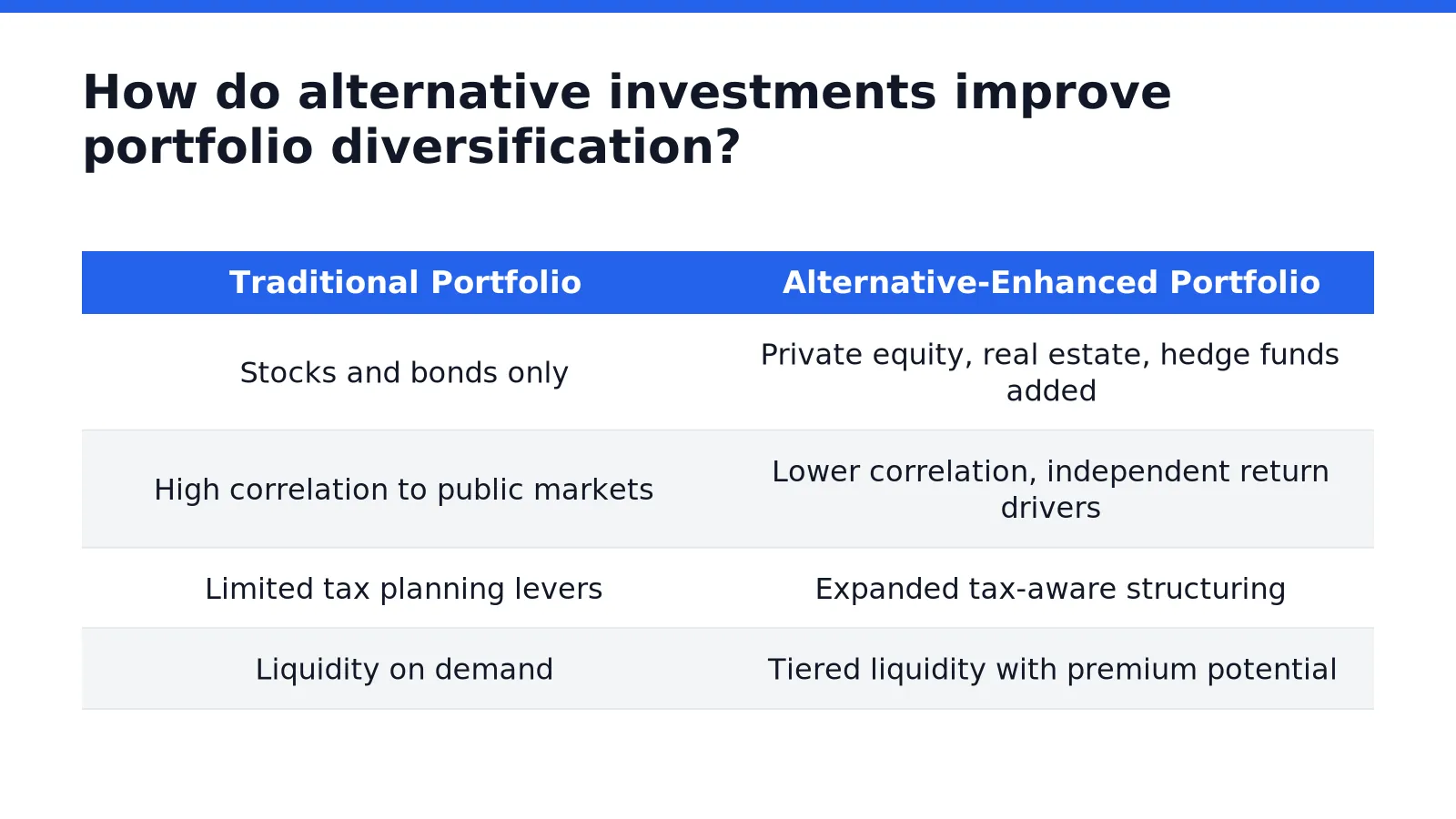
How do alternative investments improve portfolio diversification?
Alternative asset diversification works by introducing assets with return patterns that move independently from traditional stocks and bonds. This independence reduces overall portfolio risk when public markets decline. Thomas Kurinsky, senior director of custody services at Inspira Financial and a Certified Alternative Investment Analyst, emphasizes that alternative asset classes exhibit different return patterns than traditional investments. That structural difference creates a buffer. A portfolio holding private equity, real estate, or hedge funds alongside conventional equities does not rise and fall on a single market cycle.
What makes alternative return patterns different from stocks and bonds?
Alternative assets derive value from distinct economic drivers. Private real estate responds to property markets and rental demand. Private equity tracks company-level operational improvements rather than daily market sentiment. These uncorrelated movements mean a portfolio experiences smaller drawdowns during equity selloffs. The diversification benefit is structural, not coincidental.
Why do high-net-worth investors need more than a 60/40 portfolio?
The difference between average investing and strategic wealth management comes down to three variables: tax efficiency, risk alignment, and behavioral discipline. A traditional 60/40 stock-bond split concentrates risk in two correlated asset classes. Accredited alternative investment options expand the opportunity set beyond public markets. Wealth investment strategies are not about chasing trends. They are about designing a structured, tax-aware, and goal-driven framework that allows capital to compound efficiently across market cycles.
Traditional Portfolio
Alternative-Enhanced Portfolio
Stocks and bonds only
Private equity, real estate, hedge funds added
High correlation to public markets
Lower correlation, independent return drivers
Limited tax planning levers
Expanded tax-aware structuring
Liquidity on demand
Tiered liquidity with premium potential
Alternative investments require careful consideration due to liquidity constraints and regulatory implications. Investors who accept longer lock-up periods gain access to return premiums unavailable in daily-priced markets. A strategic overview of alternative investments reveals how these assets fit within a comprehensive wealth plan. The trade-off is intentional. Illiquidity compensates with higher expected returns and genuine diversification that public markets cannot replicate.

What tax advantages do alternative investments offer?
The tax advantages of alternative investments are something traditional stocks and bonds rarely match. These asset classes reduce taxable income, defer capital gains, and shield portfolios from inflation’s erosive effects. High-net-worth individuals often seek investment strategies that promise strong, consistent returns and reflect sophisticated financial goals and risk tolerance. Wealth preservation in the face of evolving market dynamics and regulatory changes is a challenge many affluent investors face. Without proactive tax structuring, a significant portion of portfolio gains disappears to unnecessary tax liability.
How do alternative investments reduce current taxable income?
Certain alternative structures generate deductions that offset ordinary income. Real estate investments, for example, produce depreciation allowances that shelter cash flow from immediate taxation. Private equity and energy partnerships frequently pass through operational losses in early years. These losses reduce an investor’s adjusted gross income dollar for dollar. The result is more capital remaining invested and compounding rather than funding quarterly estimated tax payments.
Can alternative investments defer capital gains taxes?
Yes, several structures allow investors to postpone recognition of gains indefinitely. A Delaware Statutory Trust (DST) enables participation in large-scale properties while leaving management to experienced professionals. When an investor sells appreciated real estate and reinvests through a DST, the transaction qualifies for 1031 exchange treatment. The deferred gain rolls forward into the new property. This strategy compounds wealth faster because the full sale proceeds stay invested rather than shrinking at closing. Investors seeking deeper tax optimization techniques find that combining DSTs with other alternative structures creates layered tax efficiency.
Accredited alternative investment options also include opportunity zone funds and private placement life insurance. Each vehicle addresses a different tax pressure point. Opportunity zones defer and partially eliminate capital gains on appreciated assets. Private placement structures accumulate value free from annual dividend and interest taxation. The common thread is intentional tax design built into the investment itself. Traditional mutual funds and ETFs offer no comparable mechanism.
How to access alternative investments without moving assets?
Accessing accredited alternative investment options does not require transferring existing accounts. Creative Capital Wealth Management Group delivers retainer-based planning that never requires moving assets. This structure preserves long-standing banking relationships and avoids taxable liquidation events.
The firm’s approach centers on two proprietary frameworks. The Milestone Clarification Process maps each client’s financial objectives against specific alternative opportunities. Wealth Charting then overlays tax exposure, liquidity needs, and legacy goals onto a single visual plan. Together these tools create accountability and open a clear path to accredited opportunities without disrupting current holdings.
What makes retainer-based access different from traditional advisory models?
Traditional advisors often gatekeep alternative investments behind asset minimums or custody requirements. A retainer model decouples advice from asset location. Clients pay transparent, flat quarterly fees for strategy and access. The portfolio stays where it is.
How does the Virtual Family Office support alternative investing?
The Virtual Family Office experience coordinates investments, tax planning, and estate strategy under one roof. Fully virtual collaboration works nationwide. Clients receive institutional-grade analytics and easier access to private markets, addressing what BlackRock’s US Wealth and Retirement business identifies as a clear demand among financial advisors for more transparency and better analytics. No physical relocation of assets occurs. The structure layers sophisticated oversight onto existing accounts.
Frequently Asked Questions
Why consider alternative investments for high net worth?
Alternative investments deliver diversification that traditional stocks and bonds cannot replicate. High-net-worth individuals use these assets to reduce portfolio volatility and access return sources uncorrelated to public markets.
How does Creative Capital Wealth Management Group structure alternative investment access?
Wealth Strategists evaluate each opportunity against a client’s full financial picture.
Conclusion
Alternative investments reward those who accept illiquidity and complexity with genuine diversification and tax efficiency that public markets cannot replicate. The decision to incorporate these assets requires a structured framework that aligns each opportunity with your specific tax exposure, liquidity needs, and long-term objectives. A retainer-based planning model provides this clarity without requiring asset transfers or disrupting existing relationships.