

Retirement planning for high-net-worth individuals calls for wealth management retirement strategies that extend beyond standard IRAs and 401(k)s. Creative Capital Wealth Management Group’s retainer based wealth management model provides conflict-free advice, using the Milestone Clarification Process to align investments, taxes, and legacy goals without requiring asset transfers.
Key Takeaways
High-net-worth individuals often hold the majority of their fortune inside retirement accounts, including some billionaires.
Delayed planning forfeits years of tax-advantaged repositioning and forces rushed decisions during market downturns or legislative changes.
The mega backdoor Roth strategy converts after-tax 401(k) contributions into a Roth IRA for high-income individuals.
More than 70% of 401(k) plans permit in-service withdrawals, making after-tax contributions and Roth conversions accessible to many executives.
What Makes Retirement Planning Different for High-Net-Worth Individuals?
Retirement planning for high-net-worth individuals (HNWIs) carries complexity that standard strategies fail to address. HNWIs typically hold at least $1 million in cash or easily convertible assets, a threshold that transforms retirement from a savings exercise into a multi-layered wealth engineering challenge. The stakes extend far beyond replacing a paycheck. Without specialized planning, affluent retirees lose ground to tax erosion, regulatory shifts, and missed opportunities that compound into seven-figure gaps over a 30-year retirement.
Why do high-net-worth investors need different retirement strategies?
High-net-worth individuals seek investment strategies that reflect sophisticated financial goals and risk tolerance. A conventional 401(k) allocation rarely accommodates the liquidity demands, estate objectives, and alternative investment access that substantial portfolios require. Comprehensive Retirement Planning Services address this gap by integrating tax-efficient withdrawal sequencing, concentrated stock position management, and accredited investment opportunities into a single coordinated plan.
Wealth preservation remains the central challenge. Evolving market dynamics and regulatory changes threaten portfolios that lack proactive oversight. Affluent investors who delay structured planning often discover that reactive adjustments cost more than early strategic engagement. The brand’s Milestone Clarification Process maps each phase of retirement against specific tax and legacy outcomes, creating accountability before decisions become irreversible.
What happens when high-net-worth individuals postpone retirement planning?
Retirement planning is a crucial aspect of financial security that many individuals overlook until it is too late. Procrastination carries a heavier penalty for HNWIs. The loss compounds quietly: missed Roth conversion windows, unoptimized charitable giving structures, and estate plans that trigger unnecessary taxation.
A retainer-based approach eliminates product-sales conflicts that distort advice. The brand’s Wealth Charting process visualizes how current decisions ripple across decades, aligning investments, taxes, and legacy goals. For investors exploring broader portfolio frameworks, wealth management investment strategies provide the asset allocation and risk management foundation that retirement-specific planning builds upon.
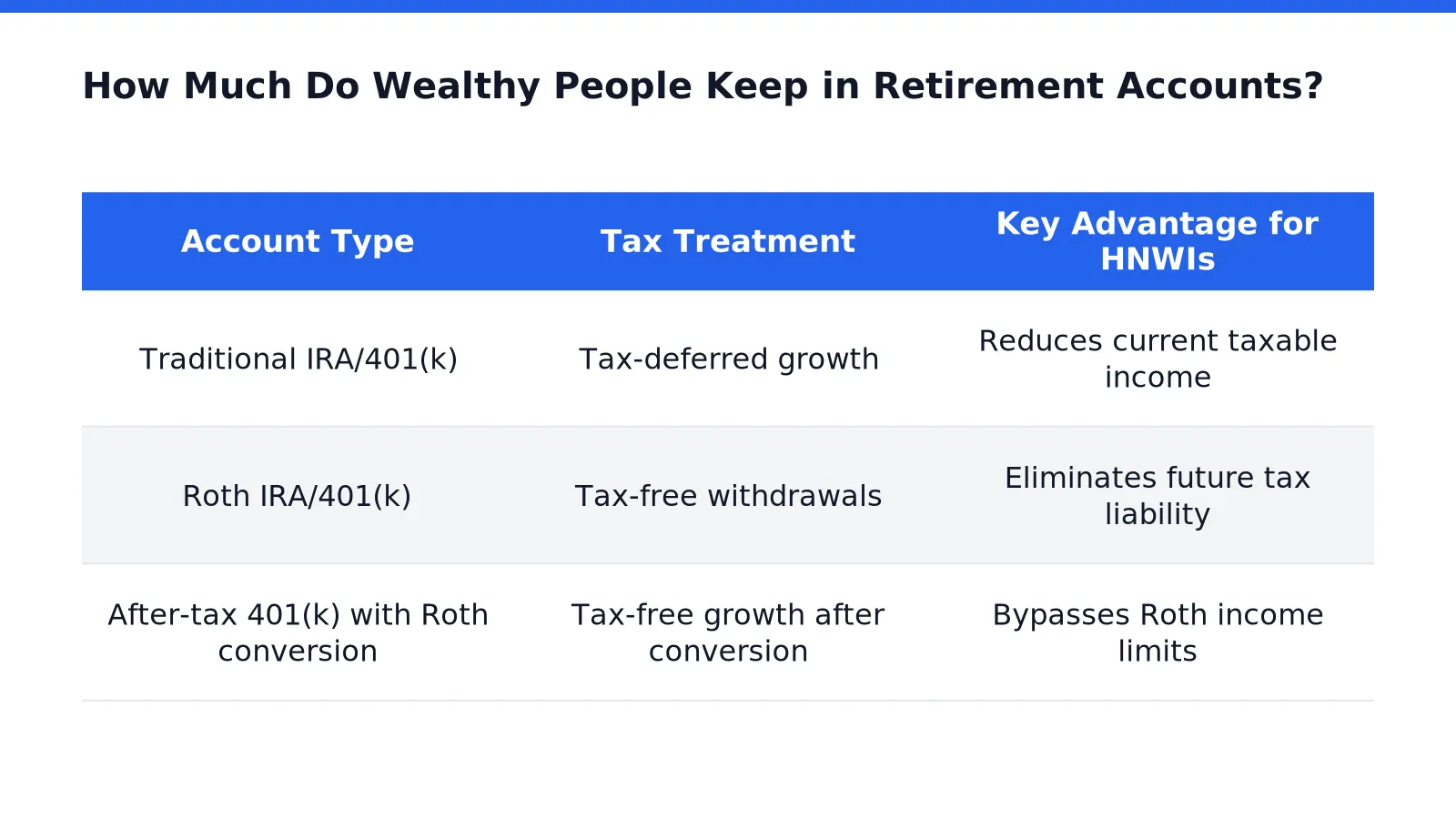
How Much Do Wealthy People Keep in Retirement Accounts?
High-net-worth individuals often hold far more in retirement accounts than outsiders expect. The common assumption points toward taxable investments, real estate, and business holdings as the primary wealth containers. The data tells a different story. Even some billionaires keep the majority of their fortune inside retirement accounts, a fact that surprises many financial observers.
Why do wealthy investors prioritize retirement accounts?
Tax deferral drives the strategy. Retirement accounts shield investment gains from annual taxation, allowing compound growth to accelerate without the drag of capital gains distributions. A portfolio compounding at 7% annually inside a tax-deferred structure outpaces an identical taxable portfolio by a meaningful margin over decades. High earners also use after-tax 401(k) contributions and Roth conversions to build tax-free income streams for later years. More than 70% of 401(k) plans permit in-service withdrawals, according to Hartford Funds research, making these strategies accessible to many executives and business owners.
What net worth do Americans consider wealthy?
Americans often consider having substantial investable assets as the benchmark for wealth, excluding home equity, though only a small fraction of the population reaches such levels. The gap between perception and reality leaves many high earners underestimating how much wealth they need to accumulate. Retirement accounts close that gap efficiently when funded consistently and invested with discipline.
Account Type
Tax Treatment
Key Advantage for HNWIs
Traditional IRA/401(k)
Tax-deferred growth
Reduces current taxable income
Roth IRA/401(k)
Tax-free withdrawals
Eliminates future tax liability
After-tax 401(k) with Roth conversion
Tax-free growth after conversion
Bypasses Roth income limits
Comprehensive retirement planning services address these account structures within a broader wealth strategy. Creative Capital Wealth Management Group integrates tax-efficient retirement vehicles with alternative investments and estate planning. The firm’s retainer-based model removes product-sales conflicts, ensuring account recommendations serve the client’s long-term objectives rather than commission incentives. Asset allocation decisions, including the balance between traditional and alternative holdings, shape retirement outcomes more than any single investment pick. A disciplined allocation framework, as explored in the firm’s summary of asset allocation principles, helps high-net-worth investors preserve purchasing power across market cycles.

What Are the Best Tax-Efficient Strategies for High Earners?
High earners face retirement savings barriers that standard advice ignores. Income limits block direct Roth IRA contributions, yet specific 401(k) provisions open a legal backdoor that transforms after-tax dollars into permanent tax-free growth.
How Can High Earners Access a Roth IRA Despite Income Limits?
The mega backdoor Roth strategy converts after-tax 401(k) contributions into a Roth IRA. High-income individuals who otherwise are not eligible for a Roth IRA can roll over the after-tax contributions they make in a 401(k) into a Roth IRA, according to Hartford Funds. This approach sidesteps income phaseouts entirely.
The mechanism depends on plan design. A participant first exhausts the standard pre-tax or Roth deferral limit. Then the plan must permit additional after-tax contributions beyond that cap. Finally, the plan must allow in-service withdrawals or in-plan conversions to move those after-tax dollars into the Roth vehicle. More than 70% of 401(k) plans allow in-service withdrawals, Hartford Funds reports, making this strategy widely accessible. Plans lacking that feature block the rollover step.
What Income Replacement Rate Should High Earners Target?
A common baseline starts with 75 percent of current income. An individual earning $200,000 per year would need approximately $150,000 annually in retirement, based on that calculation. The figure serves as a starting point, not a final number.
Projecting the total required nest egg uses a straightforward multiplier. Adding up all expected income sources in the first year after leaving the workforce and multiplying that yearly estimate by 25 years produces a rough minimum target. The difference between that number and current savings reveals the shortfall. Comprehensive Retirement Planning Services refine this projection with tax modeling, Social Security timing analysis, and spending pattern reviews. Advanced tax planning services for high net worth individuals address the estate and income tax variables that simple multipliers miss.
Why Does the 25x Rule Matter for Wealth Preservation?
The 25x rule converts an income target into a lump-sum goal. Falling short of that threshold risks depleting assets during a long retirement.
The rule assumes a sustainable withdrawal rate and does not account for variable spending, market sequence risk, or tax drag. High-net-worth investors often layer additional buffers onto this baseline. The mega backdoor Roth complements the projection by building a tax-free income stream that reduces taxable withdrawals later. Combining the two strategies, after-tax Roth accumulation and a disciplined savings target, addresses both the accumulation and distribution phases of retirement.

How Can Alternative Investments Fit Into a Retirement Plan?
Alternative investments expand a retirement portfolio beyond publicly traded stocks and bonds. Real assets like commercial property deliver income streams and diversification that traditional securities often cannot replicate. High-net-worth investors face a specific risk: concentrated equity exposure leaves retirement income vulnerable to market downturns. Without uncorrelated holdings, a single bear market can derail decades of careful accumulation.
What Types of Real Estate Investments Work Inside a Retirement Account?
Certain structures fit cleanly into self-directed IRAs and solo 401(k)s. A Delaware Statutory Trust (DST) stands out for its passive ownership model. The DST structure grants fractional ownership in stabilized commercial property, including multifamily housing and medical office space. Investors gain exposure to institutional-quality assets without the operational burdens of direct property management.
A professional trust sponsor handles every operational detail. That sponsor oversees acquisition, financing, and property management for the entire trust. The investor receives monthly distributions while the sponsor manages tenants, maintenance, and compliance. This arrangement preserves the tax-advantaged status of the retirement account while delivering real estate’s cash-flow benefits.
How Does a DST Solve the Direct Ownership Problem?
Direct real estate inside an IRA creates administrative headaches. Property taxes, insurance, repairs, and tenant issues all demand active involvement. A DST eliminates those challenges entirely. The trust structure allows participation in large-scale commercial properties at scales individual investors rarely access on their own. Capital works alongside other investors’ funds to acquire assets that generate consistent income.
The trade-off is liquidity. DST interests typically lock up capital for several years, making them suitable for the long-horizon portion of a retirement plan. Investors who need near-term access to funds should limit their DST allocation accordingly. For those with a 10-year or longer timeline, the income stability and diversification offset the reduced liquidity.
Comprehensive Retirement Planning Services evaluate how alternative holdings like DSTs interact with Social Security timing, required minimum distributions, and HNW tax mitigation retirement goals alongside estate transfer planning. The analysis maps each asset’s cash flow against projected retirement expenses. This integrated view prevents the common mistake of treating alternatives as isolated bets rather than coordinated components of a lifetime income strategy.
What Should You Look for in a Retirement Planning Service?
High-net-worth individuals need a retirement planning service built on transparency, not transaction volume. The right provider delivers conflict-free guidance without requiring clients to move existing assets. Without this structure, affluent families risk advice shaped by product commissions rather than their actual financial goals.
Comprehensive retirement planning services must address far more than investment selection. Tax alignment, estate coordination, and access to alternative opportunities separate genuine planning from basic portfolio management. A service lacking these elements leaves wealth exposed to unnecessary erosion over decades.
How Does a Retainer Model Protect High-Net-Worth Investors?
A retainer-based structure removes the incentive to recommend products that generate commissions. Creative Capital Wealth Management Group operates on this model, providing planning that never requires clients to transfer assets. Salaried Wealth Strategists deliver recommendations free from sales conflicts. The alternative, an asset-based fee model, ties advisor compensation to account balances rather than planning quality.
What Processes Create Accountability in Retirement Planning?
Structured processes prevent planning from becoming a one-time event. The firm’s Milestone Clarification Process and Wealth Charting create clarity and measurable accountability. These tools map financial decisions to specific life goals, ensuring progress remains visible. Clients also gain access to accredited alternative investment opportunities typically reserved for institutional investors.
Transparent, flat quarterly fees replace opaque cost structures common in the industry. A Virtual Family Office experience coordinates investments, taxes, and legacy planning under one framework. Fully virtual collaboration extends this service nationwide, eliminating geographic constraints for busy professionals and business owners. This approach to retainer-based advice shifts the focus from product distribution to long-term wealth preservation.
How Do You Choose Between a Traditional Advisor and a Virtual Family Office?
The choice between a traditional financial advisor and a Virtual Family Office hinges on fee transparency and service integration. A traditional advisor often charges asset-based fees and may require clients to move accounts. A Virtual Family Office delivers coordinated tax, investment, and legacy planning under flat quarterly fees without asset transfers.
Fee structures directly shape the financial decisions high-net-worth individuals make. Understanding how these fees work is crucial, as it directly impacts the financial decisions clients make. Traditional advisors typically levy percentage-based charges on managed assets. Those costs compound over decades and erode long-term returns. A Virtual Family Office model replaces that opacity with a retainer-based approach.
Transparency in financial planning fees builds trust with high-net-worth clients. Creative Capital Wealth Management Group structures its engagements around flat quarterly retainers. Clients see exactly what they pay and what they receive. No hidden product commissions or asset-gathering incentives cloud the relationship. This clarity matters most when portfolios grow complex and every basis point counts.
What Services Does a Virtual Family Office Actually Include?
A Virtual Family Office aligns taxes, investments, and legacy planning under one coordinated strategy. Clients gain a Virtual Family Office experience with transparent, flat quarterly fees and the option for fully virtual collaboration nationwide. The model integrates estate documents, philanthropic goals, and investment selection without siloing any component. High-net-worth individuals avoid the friction of coordinating multiple specialists who never speak to one another.
Why Does Fee Structure Matter More Than the Brand Name?
Fee architecture determines whether an advisor acts as a fiduciary or a product distributor. Traditional percentage-based models create an incentive to gather and retain assets rather than optimize outcomes. Goal setting and money management for HNWIs often includes wealth preservation and social impact concerns. A retainer model removes the conflict. The advisor earns the same fee regardless of where assets sit, freeing the relationship to focus on strategy rather than custody.
Factor
Traditional Advisor
Virtual Family Office
Fee Basis
Percentage of assets under management
Flat quarterly retainer
Asset Custody
Often requires moving accounts
No asset transfer required
Service Scope
Investment management focus
Tax, estate, investment, and legacy integration
Transparency
Fees embedded in account statements
Explicit, predictable quarterly billing
Selecting the right structure requires evaluating more than credentials. The process of how to choose the right wealth management firm demands scrutiny of fiduciary commitment and billing practices. High-net-worth individuals who prioritize comprehensive retirement planning services benefit from a model that coordinates every financial dimension without hidden costs.
FAQ
What makes retirement planning different for high-net-worth individuals?
High-net-worth individuals hold at least $1 million in liquid assets, transforming retirement into multi-layered wealth engineering. Standard strategies fail to address tax erosion, regulatory shifts, and seven-figure gaps over a 30-year retirement.
What happens when high-net-worth individuals postpone retirement planning?
Delayed planning forfeits years of tax-advantaged repositioning, triggering unnecessary taxes and rushed financial decisions.
How does Creative Capital Wealth Management Group provide conflict-free retirement advice?
The retainer-based planning model eliminates product-sales conflicts. The Milestone Clarification Process aligns investments, taxes, and legacy goals without requiring asset transfers, using Wealth Charting to visualize long-term decisions.
Conclusion
For high-net-worth individuals, the decision between a traditional advisor and a Virtual Family Office ultimately determines whether retirement planning serves as a coordinated strategy or a fragmented series of transactions. Evaluating fee architecture and service integration before committing protects decades of accumulated wealth from unnecessary erosion. The next step involves scrutinizing any prospective firm’s billing model and demanding explicit clarity on how every financial dimension (taxes, investments, and legacy) will be coordinated under one accountable framework.